

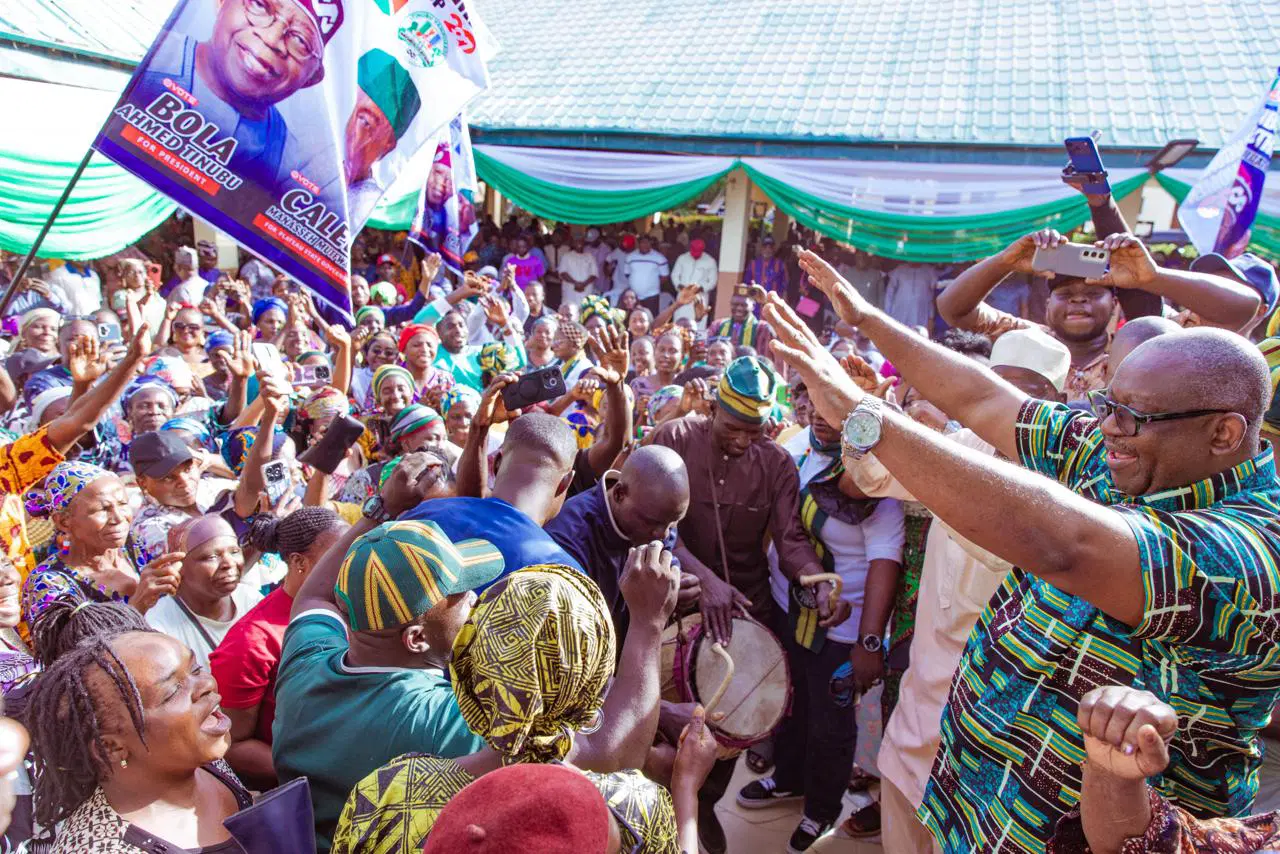
The All Progressives Congress (APC) campaign launch for the 2027 presidential election in Kaduna State has sparked disagreement between opposition figures and members of the ruling party over President Bola Tinubu’s health and the number of people who attended the event.
Sponsored Ads
Tinubu’s re-election campaign was officially launched at the Ranchers Bees Stadium in Kaduna on Saturday. However, videos and photographs from the rally triggered reactions online, with opposition figures questioning the President’s physical condition and claiming that the venue was not filled despite the importance of the event.
Sponsored Ads
While opposition figures called on Tinubu to withdraw from the race and seek medical attention, the APC dismissed the concerns, insisting that the President was healthy and capable of leading the country.
The health controversy followed a viral video showing First Lady Remi Tinubu apparently placing a substance believed by some viewers to be medication into the President’s mouth while he was seated.
The footage prompted speculation about Tinubu’s condition, with some viewers claiming that he appeared to have difficulty moving one of his hands freely. Opposition figures used the video to question his ability to cope with the demands of the presidency.
Paul Ibe, media aide to African Democratic Congress (ADC) presidential candidate Atiku Abubakar, urged Tinubu to suspend his campaign and seek medical care.
Speaking on Sunday, Ibe described the President as medically unfit to lead the country and called on his family to prioritise his well-being rather than continue taking him to political events.
He argued that Tinubu’s appearance in the video raised concerns about his health and claimed that the campaign coverage had been arranged to limit close-up views of the President while he was speaking.
Ibe also questioned the decision to continue campaigning amid the concerns, saying the President should focus on receiving appropriate medical attention.
Similarly, African Action Congress (AAC) presidential candidate Omoyele Sowore alleged that Tinubu was facing health problems and argued that Nigeria needed a leader capable of meeting the demands of the office.
Sowore acknowledged that illness could affect anyone but maintained that the President’s condition had become a matter of public concern. He rejected assurances from the ruling party that Tinubu was in good health and referred to the viral footage of the First Lady apparently giving him a substance believed to be pills.
The activist argued that the country should not have to deal with concerns about a president’s health while the person was seeking another term in office.
The APC, however, rejected the allegations, maintaining that Tinubu remained healthy and capable of governing Nigeria.
RELATED STORIES
Related Posts
Osita Okechukwu, a founding member of the party and former Director-General of the Voice of Nigeria, criticised opposition figures for discussing the President’s health without medical evidence.
In an interview, Okechukwu said such speculation was inconsistent with African cultural values and argued that political campaigns should focus on policies and issues affecting citizens rather than a candidate’s health.
He maintained that Tinubu was well and was asking Nigerians to support his bid for a second term. Okechukwu also said that people’s health should not be judged through speculation, adding that only medical professionals directly responsible for a patient’s care could properly assess their condition.
The disagreement also extended to attendance at the Kaduna rally, with opposition figures claiming that the APC failed to attract a large crowd to the campaign launch.
Political commentator Isaac Fayose alleged that the ruling party had brought supporters from different parts of the country, including Delta State, but still could not fill the stadium, which he estimated could accommodate about 5,000 people.
Fayose argued that the turnout reflected declining public support for the APC and growing dissatisfaction with the government. He also claimed that Nigerians were increasingly rejecting the ruling party.
Ibe similarly alleged that the campaign organisers had tried to conceal the level of attendance by controlling the camera angles used to cover the rally. He claimed that images from previous campaigns had also circulated online and were being used to give a misleading impression of the turnout.
The opposition figures described the rally as evidence of weakening support for the APC in the North, a region regarded as an important electoral base.
Okechukwu disputed their claims, insisting that the stadium was filled and describing the rally as successful. He said he did not observe the poor attendance alleged by opposition figures.
According to him, the choice of venue was influenced by the ongoing repairs at Ahmadu Bello Stadium, which he said could not be completed before the campaign launch. He also claimed that some supporters were unable to enter the main venue because of limited space.
Okechukwu further urged voters in northern Nigeria not to support calls for a northern presidential candidate simply because of regional identity.
He argued that those promoting Atiku Abubakar as a candidate who should receive northern support were overlooking the informal power-sharing understanding between the North and South that had shaped political arrangements since the beginning of the Fourth Republic.
The former VON director-general maintained that regional loyalty should not be the sole basis for deciding who deserves support in the presidential election, arguing that the political understanding reached at the start of the Fourth Republic should also be considered.

Comments are closed.