

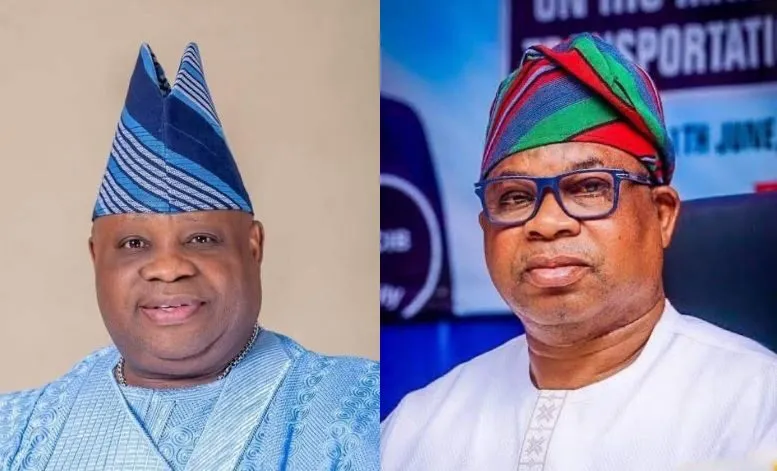
The August 15 governorship election in Osun State was reportedly marked by massive spending, with the All Progressives Congress and the Accord Party allegedly deploying more than N100 billion on activities connected to the poll.
Sponsored Ads
The funds were reportedly used for campaign operations, mobilisation, payments to party agents and canvassers, security personnel, electoral officials and alleged inducements to voters across the 3,763 polling units and 332 wards in the state.
Sponsored Ads
The reported spending far exceeds the N3 billion limit prescribed for governorship candidates under the Electoral Act 2026.
Governor Ademola Adeleke of the Accord Party won the election with 511,067 votes, defeating the APC candidate, Bola Oyebamiji, who secured 444,815 votes.
Details gathered on spending by party agents showed that APC agents were allegedly paid N100,000 each to monitor proceedings at their respective polling units, while Accord agents reportedly received N20,000 each.
Accord also reportedly funded agents from several other political parties that worked with the party during the election. The additional agents, drawn from the Nigeria Democratic Congress, New Nigeria Peoples Party, Allied Peoples Movement and All Progressives Grand Alliance, were said to have received N20,000 each.
Based on the number of polling units in Osun, the payment of N100,000 per unit by Accord for its own and affiliated agents would amount to about N376.3 million. The APC’s reported payment to its agents would also amount to the same figure.
The African Democratic Congress was also reported to have paid some of its agents N30,000, although the party did not make the payment across every polling unit, making its overall expenditure difficult to determine.
APC ward collation officers were reportedly paid N120,000 each, translating to about N39.84 million across the state’s 332 wards.
Security personnel also reportedly received payments from the political parties and the state government. The security teams deployed to polling units, comprising personnel from the police, civil defence and Federal Road Safety Corps, were reportedly paid N100,000 by the APC, N80,000 by Accord and another N50,000 from the state government.
The combined amount for those payments across the polling units was estimated at about N865.49 million.
Senior police officers were also reportedly paid N2 million each by the APC, resulting in about N62 million across the state’s 31 local government areas and area councils. No reliable figure was available for similar payments allegedly made by Accord to senior security officials.
A major part of the reported expenditure was linked to alleged vote buying.
Sources within the APC claimed the party’s initial arrangement involved giving targeted voters N40,000 each. The money was reportedly distributed in stages, with voters allegedly receiving N15,000 on two occasions before election day and another N10,000 on election day.
An APC source claimed that some local government areas received between N80 million and N100 million, while others allegedly received as much as N500 million for mobilisation and voter inducement.
Based on the reported payment structure and the party’s target of 150 voters in each polling unit, the APC’s alleged spending on vote buying was put at about N22.578 billion.
The party also reportedly recruited 30 canvassers in each polling unit and paid each person N10,000. Across the 3,763 polling units, that would amount to approximately N1.13 billion.
Accord was also alleged to have operated a similar mobilisation structure, although its reported payment per voter was lower.
The party reportedly targeted an average of 150 voters in each polling unit and allocated N20,000 per voter, which would amount to N3 million per unit and about N11.29 billion across all polling units.
Accord was also said to have used 30 canvassers in each unit, with each canvasser tasked with mobilising voters. The reported payment of N10,000 per canvasser would put the total canvassing cost at about N1.13 billion.
A senior aide to Adeleke reportedly confirmed that money was allocated for the mobilisation exercise but denied that the funds were distributed on election day.
RELATED STORIES
Related Posts
Reports from some polling units suggested that the amounts allegedly offered to voters varied considerably. In some locations, voters were reportedly offered between N70,000 and N80,000.
At one polling unit in Ilesa East Local Government Area, where former Osun governor Rauf Aregbesola reportedly voted, voters were allegedly offered N70,000. The APC won the unit with 256 votes, while Accord recorded 43 votes and the ADC received 13.
Another alleged payment of N80,000 per vote was reported at a polling unit in Odo-Otin Local Government Area.
The election spending also reportedly extended to electoral officials.
Sources claimed that APC spent about N300,000 on electoral personnel at each polling unit, while another N100,000 was allegedly allocated to security personnel.
If the N300,000 reported payment to electoral officials is applied to all 3,763 polling units, the amount would be about N1.13 billion.
An Accord official also confirmed that the party made payments to electoral personnel but said he could not establish the exact amount involved.
The scale of spending has generated competing claims from political figures on the total amount allegedly deployed during the election.
Deji Adeleke, the elder brother of Governor Adeleke and a businessman, had alleged that the APC spent more than N60 billion on the election.
Music star Davido also claimed that about N110 billion was spent by the APC.
A spokesperson for the Adeleke campaign, Pelumi Olajengbesi, repeated the allegation, claiming that the money was brought into Osun in two separate tranches of N60 billion and N50 billion.
The APC rejected the allegations, with its Osun State spokesperson, Kola Olabisi, demanding evidence to support the claims.
Olabisi maintained that the party did not need to buy votes because its candidate had sufficient support among voters to win the election.
There were also allegations against Accord over its own spending.
Former Ekiti State Governor Ayodele Fayose claimed that Accord spent at least N40 billion on the election. He also alleged that N7.5 billion was released across local governments and wards shortly before the election, with another similar amount allegedly distributed later.
The Accord campaign rejected the allegation, insisting that the party did not distribute money to voters or engage in vote buying.
The Executive Director of Yiaga Africa, Samson Itodo, said any spending above the legal limit would constitute an electoral offence if established.
He also called for investigation and prosecution where violations of the Electoral Act are confirmed.
Itodo raised concerns about the level of voter inducement reported during the election, saying such practices could undermine the ability of citizens to freely choose their preferred candidates.
The Electoral Act 2026 places the spending limit for a governorship candidate at N3 billion. The reported figures from Osun, if confirmed by investigators, would therefore represent a major breach of the legal spending ceiling.
The competing claims have increased calls for authorities to examine campaign financing, alleged vote buying and the movement of large amounts of cash during elections, particularly as political parties prepare for the 2027 general elections.

Comments are closed.