

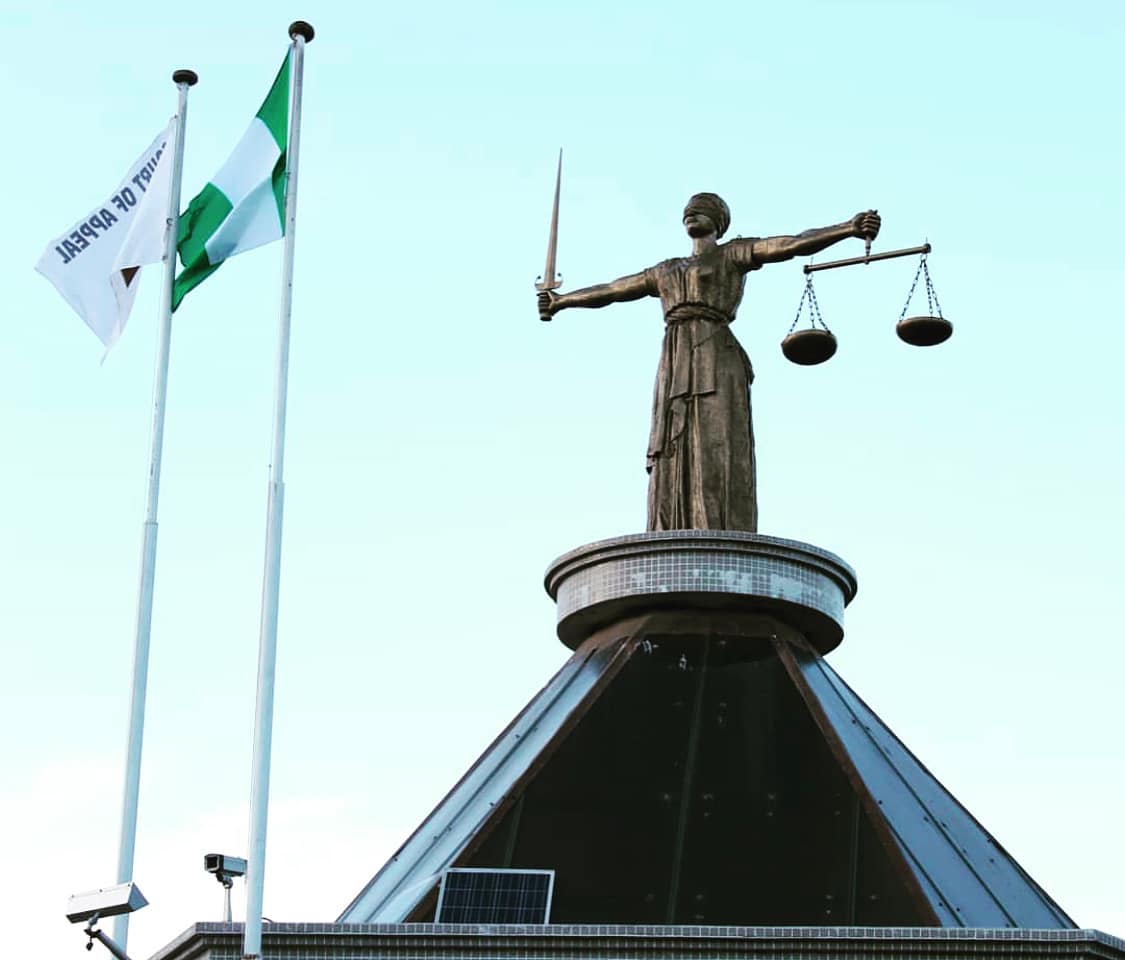
The Court of Appeal in Abuja is set to resume hearing today in the appeals seeking to overturn the Federal High Court judgment that directed the Independent National Electoral Commission (INEC) to deregister the African Democratic Congress (ADC) and four other political parties.
Sponsored Ads
The appeals will be heard by a three-member panel led by Justice Abba Mohammed.
Sponsored Ads
At the previous sitting on June 25, the appellate court completed preliminary proceedings and allowed the parties to regularise all the court processes they had filed, paving the way for the substantive hearing.
Apart from the ADC, the other political parties challenging the judgment are the Action Peoples Party (APP), Action Alliance (AA), Accord Party (AP) and the Zenith Labour Party (ZLP).
Earlier, on June 16, the Court of Appeal suspended the execution of the Federal High Court judgment pending the determination of the appeals.
The appellate court also faulted the conduct of Justice Peter Lifu of the Federal High Court in Abuja for delivering judgment despite an earlier directive ordering him to halt proceedings until the appeals before the higher court were decided.
The appellate court held that the trial judge ignored its order even after it had been brought to his attention. It criticised his action and stated that he failed to follow the judicial hierarchy expected within the court system.
Justice Lifu had ruled that INEC should deregister the five political parties after finding that they no longer met the constitutional conditions required to remain registered political parties in Nigeria.
The court also directed INEC to stop recognising the affected parties, reject their candidates for future elections and prevent them from participating in the 2027 general election.
In addition, the judge ordered the parties to stop presenting themselves as registered political parties, ruling in favour of the National Forum of Former Legislators (NFFL), which instituted the case.
The suit, marked FHC/ABJ/CS/2637/2026, asked the court to determine whether INEC has a constitutional duty to deregister political parties that fail to meet the performance requirements contained in Section 225A of the 1999 Constitution, as amended, alongside the Electoral Act 2022 and the commission’s regulations.
The former lawmakers argued that the ADC and the other parties had repeatedly failed to satisfy the constitutional conditions required to retain their registration.
According to the plaintiffs, the requirements include securing at least 25 per cent of votes in one state during a presidential election or winning at least one elective office at the national, state or local government level.
They maintained that the five parties failed to achieve those benchmarks during the 2023 general election and subsequent by-elections, making their continued recognition unlawful.
RELATED STORIES
Related Posts
The plaintiffs also argued that allowing the parties to remain registered weakens the country’s electoral process.
The Attorney-General of the Federation and Minister of Justice, Prince Lateef Fagbemi (SAN), who is also a defendant in the matter, supported the position of the plaintiffs.
Court documents filed on behalf of the Attorney-General argued that retaining political parties that no longer meet constitutional requirements is inconsistent with the law and weakens the integrity of Nigeria’s electoral system.
The Attorney-General further maintained that unless the court intervenes, INEC would continue to fail in its constitutional responsibility by retaining parties that no longer qualify for registration.
However, INEC and all the affected political parties have appealed the judgment and asked the Court of Appeal to set it aside.
Meanwhile, the Federal High Court in Abuja has ordered the National Welfare Secretary of the ADC, Nkemakolam Ukandu, to pay N100 million after dismissing his suit against two judges.
Justice Salim Ibrahim directed Ukandu to pay N50 million each to the Chief Judge of the Federal High Court, Justice John Tsoho, and Justice Peter Lifu. The court ordered that the payment must be made within 14 days.
The judge also struck out the case after finding that the plaintiff failed to prosecute it diligently.
Ukandu had sued the two judges, accusing them of bias and disobeying a directive of the Supreme Court in relation to the leadership dispute within the ADC. He also joined the National Judicial Council (NJC) as a defendant.
In the suit marked FHC/ABJ/CS/1165/2026, he asked the court to compel the NJC to investigate allegations of corruption, abuse of judicial authority and bias against the judges.
He also challenged the reassignment of the case involving the leadership of the ADC, led by Senator David Mark, from Justice Emeka Nwite to Justice Peter Lifu.
When the matter came up on Monday, neither Ukandu nor his lawyer appeared before the court.
Having earlier warned that the suit could be dismissed if the plaintiff failed to appear, Justice Ibrahim struck out the case and awarded punitive costs against him.

Comments are closed.