

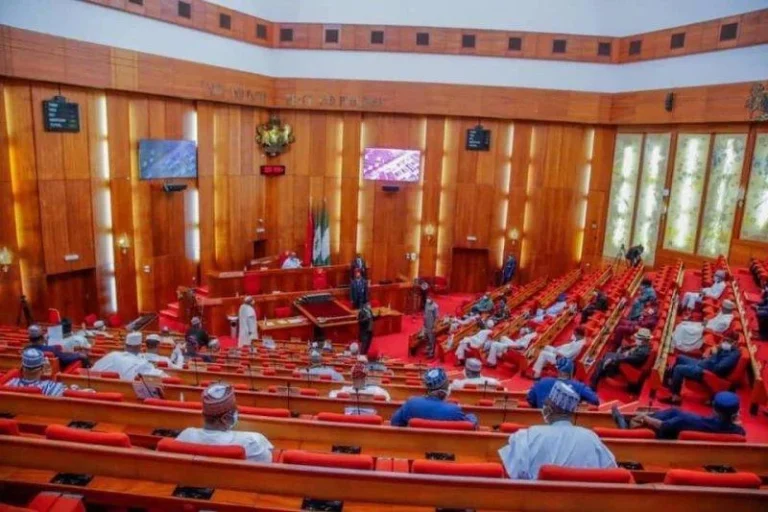
The Senate has assured Nigerians that legislation to establish state police will be enacted before the end of 2026, following the approval of the proposed constitutional amendment by the required number of state Houses of Assembly.
Sponsored Ads
The latest approval came on Monday when the Ondo State House of Assembly passed the Constitution of the Federal Republic of Nigeria, 1999 (Sixth Alteration) Bill, 2026, seeking to establish state police services. The bill passed second and third readings during plenary, with all members present supporting it.
Sponsored Ads
Ondo joined 23 other states that had already approved the amendment, bringing the total to 24 and meeting the constitutionally required two-thirds threshold for consideration by the National Assembly.
The Chairman of the Senate Committee on Media and Public Affairs, Yemi Adaramodu, said the National Assembly was determined to complete the legislative process before its Christmas break.
Adaramodu described state police as a priority in the ongoing constitutional review, assuring Nigerians that the proposed legislation would be considered quickly once the necessary proposals were formally received from the executive.
He said the Senate had committed to ensuring that a new police law was enacted before the end of the 10th National Assembly, adding that lawmakers intended to conclude the process before proceeding on their Christmas recess.
The assurance comes as the Presidential Working Group on the National Policing Bill submitted the draft National Policing Bill, 2026, alongside 29 consequential amendment bills, to the Ministry of Justice for legislative drafting review and validation.
The working group, chaired by the Chief of Staff to the President, Femi Gbajabiamila, expected the ministry to return the validated drafts by October 30. The group would then consider the documents before presenting them to President Bola Tinubu for approval and subsequent transmission to the National Assembly.
Gbajabiamila had earlier indicated that the bill was about 90 per cent ready and would be sent to the National Assembly on October 29.
However, Adaramodu declined to comment on the executive’s proposed timeline, saying the Senate would wait until it formally received the bills before taking a position.
He also dismissed concerns about delays in obtaining state-level approval, explaining that the 30-day period was intended for state legislatures to submit their contributions to the constitutional amendment process.
According to him, the state assemblies had been sending in their inputs, which would be reviewed during a conference as part of the legislative process.
Adaramodu expressed confidence that the process would be completed before the end of the year, describing state policing as necessary to strengthen Nigeria’s response to insecurity.
He said the proposed law would not be delayed unnecessarily but stressed that relevant stakeholders, including those whose views might not be considered central to the process, would be given opportunities to contribute because the legislation would affect communities across the country.
RELATED STORIES
Related Posts
The Senate spokesman argued that state police could improve the enforcement of security laws and strengthen efforts to tackle killings, kidnappings, banditry and terrorism.
He maintained that while the National Assembly had enacted several laws intended to deter criminal activities, effective enforcement remained a major concern. In his view, decentralised policing could improve the implementation of those laws compared with the existing centralised system.
Also speaking on the development, the senator representing Anambra Central, Victor Umeh, said the approval by 24 state assemblies meant the constitutional amendment had met the required threshold.
Umeh explained that the amendment would return to the National Assembly for verification of the submissions from the state legislatures.
He said lawmakers supported decentralised policing because Nigeria’s size made it difficult for a single central police force to respond effectively to security challenges in every community.
According to him, establishing state police commands would bring security operations closer to residents and improve intelligence gathering, particularly where officers have a better understanding of local conditions.
Umeh argued that criminals often operate within communities where residents may have knowledge of their activities, adding that locally informed policing could help security agencies respond more quickly to threats.
The proposed constitutional amendment seeks to alter Section 214 of the Constitution to replace the existing Nigeria Police Force with a Federal Police Service and State Police Services.
The Senate passed the Sixth Alteration Bill on June 24, after which the House of Representatives also approved it. The National Assembly transmitted the bill to the 36 state Houses of Assembly on September 16 for consideration.
During Monday’s plenary in Ondo, the Assembly’s Majority Leader, Olatunji Oshati, moved the motion for the bill’s passage, which was seconded by Allen Oluwatoyin, who represents Ese Odo State Constituency.
Oshati said lawmakers had carefully considered the implications of the amendment for Nigerians, arguing that state police could help address the country’s security challenges.
The Speaker of the Ondo State House of Assembly, Olamide Oladiji, described the proposed establishment of state police as long overdue, saying it would enable security agencies to respond more swiftly to crime and other threats.
He added that state policing could help reduce criminal activities through improved intelligence gathering and proactive security measures.
Oladiji subsequently directed the Clerk of the House, Benjamin Jaiyeola, to transmit the approved bill and the state legislature’s observations to the National Assembly.

Comments are closed.