

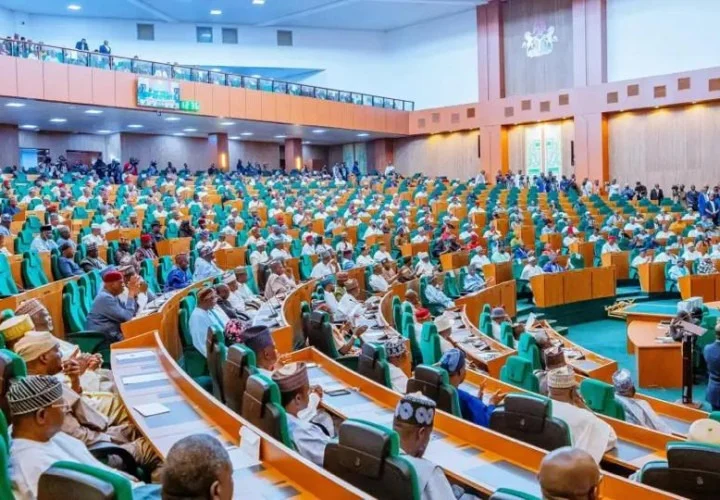
The House of Representatives Special Ad-hoc Committee on Constitution Review is scheduled to meet on Monday to examine the State Police Bill submitted by President Bola Tinubu as part of efforts to advance the proposed constitutional amendment.

Sponsored Ads
The bill provides a framework for establishing state police across the country while setting national minimum standards that every state police service must meet before becoming operational.
Sponsored Ads
The committee, headed by the Deputy Speaker of the House, Hon. Benjamin Kalu, will consider the 26-clause bill, which recently passed its second reading in the House of Representatives.

LIST OF APPLICATIONS FOR REGULARISATION OF AREA COUNCIL LAND DOCUMENTS NULLIFIED/CANCELLED BY THE HONOURABLE MINISTER OF FCT
The latest deliberation follows the House’s earlier decision to reverse the version of the State Police Bill passed in June after a motion sponsored by the Chairman of the House Committee on Rules and Business, Hon. Francis Waive.
During the debate that led to the reversal, Waive explained that a 12-member Conference Committee had already been constituted to harmonise the positions of both chambers of the National Assembly on the proposed State Police Services before the legislative process continued.
The Executive Bill seeks to amend several sections of the 1999 Constitution to establish a dual policing structure under which the Federal Police Service would continue to handle federal policing responsibilities, while individual states would be allowed to create and operate their own police services.
The proposal also includes the establishment of State Police Service Commissions in every state to supervise the appointment, discipline and administration of state police personnel.
To give legal backing to the new structure, the bill proposes amendments to several constitutional provisions, including Sections 84, 89, 121, 124, 129, 153, 157, 158, 160, 197, 201 and 204, among others. It also seeks changes to parts of Chapter VI, the Second Schedule, the Third Schedule, the Fifth Schedule and Section 318 of the Constitution.
RELATED STORIES
Related Posts
According to the explanatory memorandum accompanying the bill, the Federal Police Service will remain the recognised policing institution in every state until a state successfully establishes its own police service and receives certification that it meets the national standards laid down by an Act of the National Assembly.
The proposal also provides safeguards covering civilian oversight, protection of human rights, national policing standards, independent police service commissions, cooperation between federal and state authorities, criminal information management, firearms regulation and circumstances under which the Federal Government may intervene if a state police service experiences serious operational failure or poses a threat to national security.
While the constitutional amendment sets out the broad legal framework, the bill leaves detailed operational matters such as organisational structure, operational procedures, certification process, complaint mechanisms, grants and implementation arrangements to future legislation by the National Assembly and the various State Houses of Assembly.
The proposed amendment is also intended to redefine the responsibilities of the Federal Police Service and State Police Services within Nigeria’s security system while setting uniform policing standards across the country.
In addition, the bill seeks to amend the constitutional definition of the public service by replacing references to the Nigeria Police Force with the Federal Police Service and formally recognising officers and staff of State Police Services and State Police Service Commissions as members of the public service.
Another major provision deals with the removal of police leadership. Under the proposal, the Inspector-General of the Federal Police Service may only be removed by the President after a resolution supported by a two-thirds majority of the Senate on grounds such as misconduct, incapacity or gross violation of the Constitution. A similar procedure is proposed for the removal of a State Commissioner of Police by a governor, subject to the approval of two-thirds of the members of the State House of Assembly.
The bill further proposes replacing Section 214 of the Constitution to formally establish both the Federal Police Service and State Police Services. However, no state police service will begin operations until it has been created through a state law and certified as meeting the required national standards. Until that happens, the Federal Police Service will continue to perform policing duties in the affected state.
Even after a state police service becomes operational, the Federal Police Service will retain responsibility for federal policing matters and may provide assistance to state police authorities whenever necessary.
Unless there are last-minute changes, the Special Ad-hoc Committee is expected to submit its report to the House when lawmakers resume plenary for further consideration of the proposed constitutional amendment.

Comments are closed.