

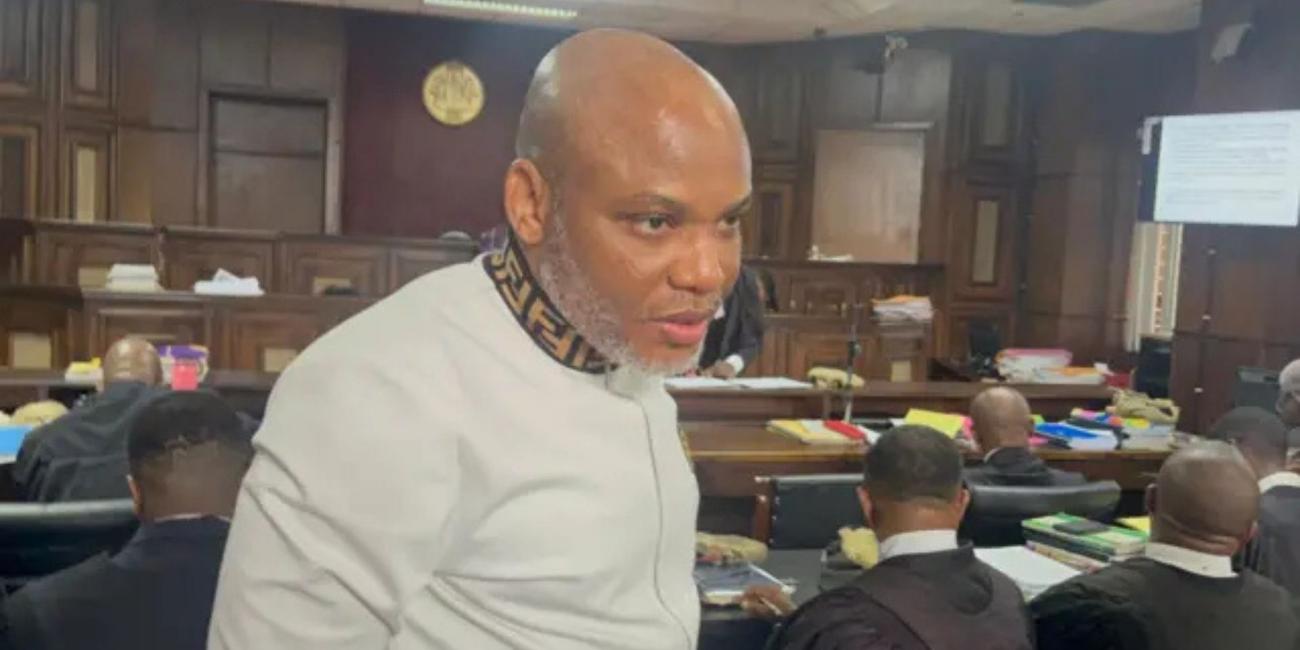
Legal consultant to the detained IPOB leader, Nnamdi Kanu, Barrister Jude Njoku, has taken a strong stance against the Supreme Court’s December 15, 2023 decision to remit Kanu’s case for trial, describing it as unconstitutional and without legal standing.

Sponsored Ads
The legal practitioner made his position known in a detailed critique titled “A Devastating Critique: The Nigerian Supreme Court’s Unlawful Remittal of Nnamdi Kanu’s Case, the Inviolability of Section 36(9) Immunity, and the Universal Doctrine of Finality of Appellate Discharge.” Njoku, who serves as a consultant to the Nnamdi Kanu Global Defence Consortium, accused the apex court of breaching the Nigerian Constitution by reversing a discharge that had already been finalized by the Court of Appeal.
Sponsored Ads
The controversy stems from the Court of Appeal judgment of October 13, 2022, which discharged Kanu of all charges filed against him. Njoku argued that once the appellate court reached its decision, the matter was legally concluded, leaving no constitutional basis for a retrial. He said the constitutional protection under Section 36(9) of the 1999 Constitution shields any person discharged by a competent court from being tried again for the same offence.

LIST OF APPLICATIONS FOR REGULARISATION OF AREA COUNCIL LAND DOCUMENTS NULLIFIED/CANCELLED BY THE HONOURABLE MINISTER OF FCT
According to him, this immunity is automatic, absolute, and beyond the reach of any judicial body, including the Supreme Court. He claimed that the apex court’s decision to remit the case, without reversing the finding of illegal rendition or introducing new evidence, was an act that placed the judiciary above the very constitution it swore to uphold.
RELATED STORIES
Related Posts
Njoku further argued that by reactivating a case already settled by the Court of Appeal, the Supreme Court undermined the doctrine of finality in appellate judgments, which ensures that once a higher court discharges a case, it is closed permanently. He said this doctrine is recognised in legal systems across common-law countries such as England, Canada, and Australia, and should apply equally in Nigeria.
He also faulted the composition of the Supreme Court panel, noting that a five-member bench cannot overturn decisions made by a larger seven-member constitutional panel. He described this as an internal breach of judicial order and a move that weakens the institutional authority of the court.
Njoku maintained that the remittal judgment was legally void, describing it as an act of judicial overreach and a violation of both the Nigerian Constitution and the African Charter on Human and Peoples’ Rights, which forms part of the nation’s supreme law. He stated that the apex court’s ruling was not just a misstep but a fundamental breach that calls into question the integrity of constitutional governance.
He concluded that the Supreme Court’s action amounted to a direct challenge to the rule of law and to the supremacy of the Constitution, asserting that once an appellate discharge is given, it marks the end of the case with full and final effect.

Comments are closed.