

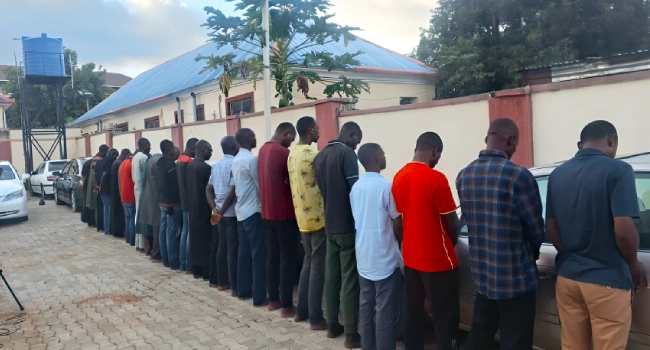
A Federal Government investigation has revealed that suspected illegal miners detained at the Niger State Command of the Nigeria Security and Civil Defence Corps (NSCDC) were forced to drink urine or sweat because they had no access to drinking water before 33 of them died in custody.

Sponsored Ads
The findings were contained in a report submitted by an independent 10-member investigation committee established by the Federal Ministry of Interior to examine the deaths.
Sponsored Ads
Led by Jonathan Kure, the committee found that the male detention cell had no running water and its toilet was not functioning. Survivors reportedly endured extreme heat, dehydration and overcrowding in a cell measuring approximately 12 square metres, where they had little room to move.
The report authenticated the deaths of 33 detainees inside the male cell between 8 p.m. on September 16 and 7 a.m. on September 17. It also identified 41 survivors and established that approximately 50 male detainees, including children, had been confined in the facility.
The committee said the cell had a solid metal door and inadequate ventilation. It further found that officers responsible for the facility failed to address the overcrowding, ignored prolonged cries and banging on the cell door and walls, and did not provide emergency assistance.
Conditions in the female cell were also poor. Detainees had no drinking water apart from supplies brought by relatives, while the toilet was not functioning properly and could only be used with fetched water. The report also stated that relatives were prevented from bringing food to detainees on Wednesday, September 16.
The committee established that warnings about the dangers of overcrowding had been raised before the deaths occurred.
Mariam Nelson, a member of the NSCDC medical unit, told investigators that she warned the cell guards, Usman Ndamaka and Hassan Mohammed, on the evening of September 16 that the overcrowded conditions could lead to suffocation.
She said she advised them to leave the metal door unlocked to improve ventilation, but they did not act on her warning.
According to the report, detainees began experiencing eye irritation, burning throats, breathing difficulties, excessive sweating and intense thirst from around 7:15 p.m. that evening. They later started shouting for help and pleading for drinking water.
An armoury guard, Ahmed Abubakar Wushishi, told the committee that he heard persistent screams and banging from the cell between 1 a.m. and 2 a.m. on September 17.
RELATED STORIES
Related Posts
He said he approached the night guard, Hassan Mohammed, and urged him to open the cell. However, Mohammed reportedly refused, saying his superior, Ndamaka, had instructed him not to open the door without armed backup because the detainees might be planning to escape.
Wushishi said the cries and banging eventually stopped at about 2:30 a.m.
Ndamaka admitted that he had directed the night guard not to open the cell without armed support. He also acknowledged that he failed to respond to an emergency call from Mohammed at 10:37 p.m. on September 16, explaining that he had been asleep.
He reportedly returned the call at about 6 a.m. and arrived at the facility around 7 a.m., when the cell was opened and the bodies discovered.
The investigation also raised concerns over the detention of children alongside adults. It found that 14 of the 33 deceased detainees were minors.
Four other children below the age of 14 had been recorded during the profiling process but were still transferred into adult detention cells.
The profiling officer, Abubakar Dabban, admitted to recording the four children but processing them into the adult facility. The committee said this violated child-protection requirements and the rights of the minors. It also condemned the practice of keeping children and adults together in the overcrowded cell.
On the cause of death, the committee identified acute hypoxic respiratory failure, also known as environmental asphyxia, aggravated by heat stress and dehydration.
However, it explained that the medical conclusion was based on post-mortem examinations conducted on only three bodies because the other 30 detainees had already been buried before the medical team arrived.
The report identified oxygen deprivation as the immediate cause of death. It attributed the wider circumstances to failures in the duty of care by NSCDC officers, poor detention facilities, inadequate emergency medical arrangements and weak institutional supervision.
The committee also rejected suggestions that a disease outbreak caused the deaths, stating that the available medical and forensic evidence did not support that explanation.
It recommended that officers found responsible should face prosecution for applicable offences, including murder, criminal negligence, torture and inhuman treatment.

Comments are closed.