

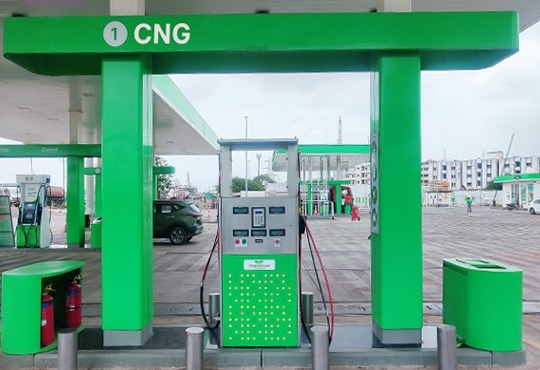
Transport fares have remained largely unchanged across several states despite President Bola Tinubu’s directive that the use of Compressed Natural Gas (CNG)-powered buses should begin bringing down transportation costs from October 1.
Sponsored Ads
Checks across a number of states showed that many commuters continued to pay the same fares they had been paying before the October 1 target, while some routes recorded higher charges.
Sponsored Ads
Although some state governments have introduced subsidised, free or cheaper transport services using CNG and electric vehicles, the schemes remain limited to selected routes and sections of the population. Many commuters therefore still depend on privately operated buses whose owners face high fuel, spare parts and maintenance costs.
States where transport fares were reported to have remained largely unchanged included Enugu, Anambra, Delta, Imo, Sokoto, Kebbi, Jigawa, Gombe, Edo, Plateau, Ondo, Osun, Oyo and Ogun.
Tinubu had on September 19 directed state governments to ensure that savings from cheaper CNG-powered transportation were passed on to Nigerians through lower fares from October 1.
The directive followed an August 27 meeting between the President and the 36 state governors on the National Affordable CNG Transit Programme. The initiative was designed to expand the use of CNG and electric vehicles while reducing the cost of public transportation.
The Chairman of the Presidential Initiative on Compressed Natural Gas and Electric Vehicles, Ismaeel Ahmed, said several states had already started reducing fares through the deployment of CNG and electric vehicles.
He listed Borno, Kaduna, Zamfara and Ebonyi among states where alternative-fuel transportation had already produced lower fares.
Ahmed explained that October 1 was not intended as a date when every state would simultaneously reduce fares. Rather, he said, it marked the beginning of federal monitoring of fare reductions on routes where CNG and electric buses were operating.
He said Abuja had operated CNG buses on several high-traffic routes for some time, while Lagos had also received 20 CNG buses for use by the Lagos Metropolitan Area Transport Authority.
According to him, Zamfara had introduced 100 electric taxis, while Ebonyi offered free transportation to some civil servants and students.
Borno was also cited as an example where electric vehicles had been deployed at substantially lower fares than those charged by conventional commercial operators.
However, checks in several states showed that the broader transport sector had yet to benefit from the expected reductions.
In Anambra, fares remained unchanged, with passengers paying about N700 from Upper Iweka to Oba and around N2,000 between Awka and Onitsha. Some transport operators said they were unaware of the deployment of CNG buses, while inadequate gas infrastructure was also reported.
Drivers blamed expensive spare parts, poor roads and diversions caused by road construction for the continued high fares.
In Delta State, transport operators also reported no reduction. Only a few CNG-branded buses were observed in Asaba, while the National Union of Road Transport Workers said it had not received CNG buses and therefore had no basis to reduce fares.
Imo State recorded a similar situation. Commercial operators said they had yet to receive CNG buses, with fares remaining high on major routes. A trip from Owerri to Akokwa was reportedly costing N4,500, while the journey from Owerri to Awka could reach N9,000.
Transport operators in the state also pointed to the dominance of privately owned buses as a challenge to the implementation of a government-led CNG transport programme.
RELATED STORIES
Related Posts
In Sokoto and Kebbi, fares were also unchanged. Passengers travelling from Sokoto to Kebbi continued to pay between N5,000 and N6,000, while trips to Kano or Kaduna cost about N20,000. In Kebbi, state-owned buses charged N3,500 for the Sokoto route, compared with about N5,000 on commercial vehicles.
Jigawa residents similarly reported no reduction in fares. A journey from Dutse to Kano remained around N3,500, while Dutse to Hadejia cost about N5,000. However, the state chairman of the National Association of Road Transport Owners said about 100 vehicles belonging to members had been converted to CNG under the government initiative.
In Gombe, passengers said fares to Abuja and Kaduna had not changed. The state transport service said it was considering alternative measures to prevent further fare increases and was working towards converting some buses to CNG.
Edo State also recorded no immediate reduction. Short trips in Benin remained between N200 and N300, while longer journeys cost between N500 and N600. Transport operators cited high spare-parts costs and inadequate gas infrastructure, including long waiting times at refuelling points.
The Edo State Government, however, said it planned to introduce 50 52-seater CNG buses later in October. The buses are expected to be distributed across the three senatorial districts.
In Enugu, government-operated CNG buses were offering a flat N300 fare on selected routes, compared with N600 charged by commercial buses for some of the same journeys. However, limited routes and operating hours meant that many commuters still depended on conventional buses.
Kaduna provided one of the more extensive government-supported alternatives, with 100 CNG buses operating on eight routes. The state government said the buses had transported about 3.2 million passengers in their first year and saved commuters more than N3.5 billion.
Despite the free CNG service on selected routes, commercial fares outside the network remained considerably higher, limiting the benefit to passengers who could access the designated routes.
In Plateau State, CNG buses were yet to begin operating, while government-owned buses continued to charge N200. Commercial operators charged substantially more, with one passenger reporting a N1,000 fare from Bukuru to Terminus.
The state government said its subsidised transport scheme was already providing cheaper services to about 13,000 passengers daily. It also disclosed plans to establish a CNG and hybrid vehicle conversion centre in Jos, although the absence of a refuelling facility remained a challenge.
Ondo State had also not recorded an immediate reduction, with no CNG buses observed operating across the state. Officials said plans were underway to establish conversion centres and expand gas outlets.
In Osun, fares remained unchanged as the state awaited CNG buses promised by the Federal Government. The state government also cited financial constraints as a limitation to providing immediate subsidised transportation.
Oyo State recorded a similar situation, with fares on major Ibadan routes remaining at levels introduced after the increase in petrol prices. The Ojoo-Mokola route remained around N600, while Ojoo-Iwo Road cost between N400 and N500.
Ogun State also recorded no immediate reduction. A trip from Kuto to Ijebu Ode remained about N3,500, while Kuto to Ita Oshin cost between N600 and N700 and Kuto to Sagamu was N2,000 or more.
Transport operators in the state said fuel prices, maintenance costs and other operating expenses continued to make lower fares difficult.
The Ogun State Government said it would announce further measures in response to the Federal Government’s directive.
The varying experiences across the states indicate that while CNG and electric transport schemes have produced lower fares in some locations, limited vehicle availability, inadequate refuelling infrastructure, conversion challenges and the dominance of private transport operators have slowed the wider reduction in fares.

Comments are closed.