

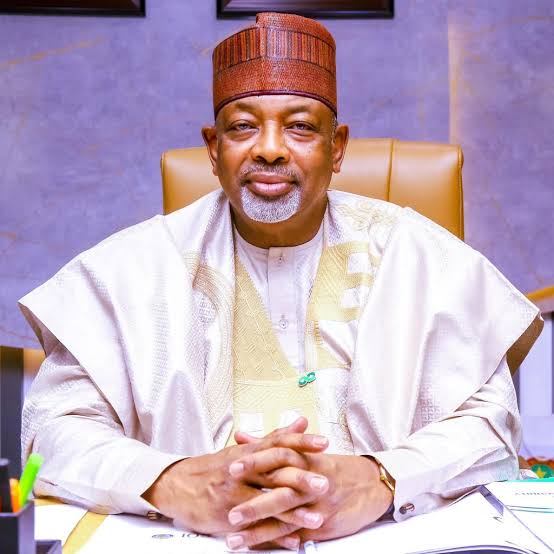
The Minister of Agriculture and Food Security, Abubakar Kyari, has said Nigeria’s food production has increased under the President Bola Tinubu administration, but weak processing and distribution systems continue to keep prices high for consumers.
Sponsored Ads
Kyari explained that farm-gate prices had reduced as agricultural production improved, but the decline had not fully reached consumers because of challenges between farms and markets.
Sponsored Ads
The minister made this known during an interview on Friday while discussing concerns over the slow impact of the government’s agricultural reforms on food prices.
He said the government had recorded progress in food production, but agro-processing remained one of the major areas requiring attention. According to him, the reduction in production costs at the farm level had not been matched by a similar decline in processing costs.
Kyari attributed Nigeria’s continued reliance on food imports to several factors, including rapid population growth, low agricultural productivity, limited access to farmland and the cost of inputs required by farmers.
He said Nigeria’s population was growing by an estimated eight to nine million people annually, creating additional pressure on food production. He added that improving access to quality seeds, land and affordable farm inputs remained necessary to increase productivity.
The minister said the Federal Government had provided subsidised inputs and seeds to many farmers as part of efforts to improve agricultural output.
On processed food imports, Kyari said the government was working to reduce dependence on foreign products by expanding mechanisation, local processing and the Special Agro-Processing Zones (SAPZ).
He said the SAPZ programme was designed to link food production with aggregation, storage, processing and marketing. Eight zones are expected to become operational before the end of next year, while preparations are also being made for a second phase involving about 10 states.
RELATED STORIES
Related Posts
Kyari also pointed to restrictions on the export of some raw agricultural commodities as part of efforts to encourage local value addition and reduce the export of unprocessed materials.
The minister said improved security had also allowed farmers to return to some areas where insecurity had previously prevented cultivation. He said more farmland became accessible in 2024 and 2025, resulting in increased harvests.
According to Kyari, the government is awaiting the 2026 agricultural production figures, which are expected between October and November. He said future data would also be released at different harvest cycles to support the government’s push for year-round farming.
Kyari projected that the 2026 harvest would surpass the output recorded in 2025. He linked the expected increase to improved productivity, more stable input prices and various government interventions in the agricultural sector.
He said the Federal Ministry of Agriculture, the Bank of Agriculture and the National Agricultural Development Fund had provided support to farmers. The National Agricultural Development Fund provided fertiliser at no cost in some interventions, while the Bank of Agriculture offered a 50 per cent subsidy.
On mechanisation, Kyari said tractors supplied under the Nigerian Agricultural Mechanisation Policy had already been deployed to farms. He explained that the government was monitoring their performance to ensure each tractor covered between 500 and 600 hectares annually.
He said the target would allow tractors serving smaller farms to also work on neighbouring farms, thereby increasing the area cultivated each year. With 2,000 tractors, the government expects to cover about one million hectares annually for land preparation.
The minister said the combination of increased production, improved security, mechanisation and local processing was expected to address some of the gaps keeping food prices high despite rising agricultural output.

Comments are closed.