

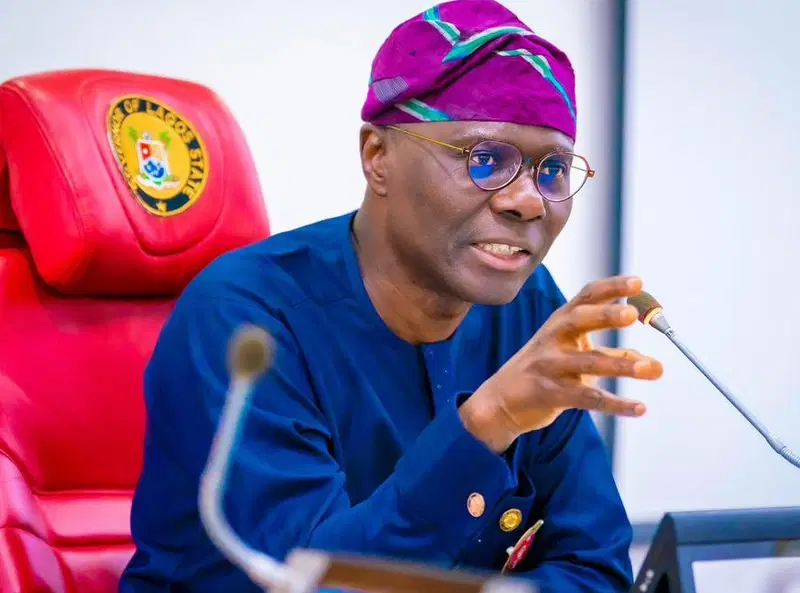
Lagos State Governor Babajide Sanwo-Olu has criticised plans by some opposition politicians to restore the fuel subsidy, saying such promises are unlikely to provide a lasting solution to Nigeria’s economic challenges.
Sponsored Ads
Sanwo-Olu said politicians campaigning on the return of petrol subsidy were relying on popular sentiments ahead of the 2027 election rather than offering policies that could be sustained by the country’s finances.
Sponsored Ads
The governor spoke in Lagos while delivering a lecture at the seventh Freedom Online Newspaper Lecture, which focused on the 2027 elections, the economy, security and Nigeria’s future.
The event, published by journalist Gabriel Akinadewo, was attended by political leaders and media professionals. Former Minister of Information and Culture, Lai Mohammed, chaired the programme, while former Ogun State Governor and Ogun East Senator, Gbenga Daniel, served as the Special Guest of Honour.
The debate over the possible return of fuel subsidy was recently revived by former Vice President and African Democratic Congress presidential candidate, Atiku Abubakar, as he began preparations for the 2027 presidential election.
Atiku has criticised the handling of the funds saved from subsidy removal and proposed measures aimed at making petrol more affordable. However, Sanwo-Olu argued that returning to the old subsidy system would place another burden on government finances.
The Lagos governor said the removal of petrol subsidy was introduced because the previous arrangement had become too costly for the country. He argued that large amounts of public funds were being used to support the scheme instead of being directed towards infrastructure and other development needs.
According to him, the policy was never intended to remain a permanent government intervention. He said the subsidy system had also failed to deliver its full benefits to ordinary Nigerians while putting pressure on the national treasury.
Sanwo-Olu acknowledged that the removal of subsidy had created hardship for Nigerians, particularly through higher petrol, transportation and food prices. He, however, argued that the government should judge the policy based on its long-term results rather than the immediate difficulties caused by the reform.
He said the additional revenue available to states and local governments after the removal of subsidy had increased their monthly allocations considerably. Sanwo-Olu maintained that state governments now have more resources available to fund development projects.
The governor also defended the broader economic reforms introduced by President Bola Tinubu, saying they were beginning to produce improvements in several areas of the economy.
He pointed to recent figures on economic growth, agriculture, services, foreign reserves, inflation and remittances as signs that the reforms were moving the country towards recovery.
Sanwo-Olu said the National Bureau of Statistics recorded economic growth of 4.43 per cent in the second quarter of 2026, compared with 3.89 per cent in the first quarter.
He also said Nigeria’s foreign reserves had increased to about $53 billion, while inflation declined to 15.9 per cent in June from nearly 35 per cent in late 2024.
RELATED STORIES
Related Posts
The governor further noted that formal remittances from Nigerians living abroad reached $947 million in July, which he described as the highest monthly figure recorded.
He argued that these developments should be considered when assessing the impact of the Tinubu administration’s policies, while calling for more efforts to ensure that ordinary Nigerians begin to feel the benefits of the reforms.
Sanwo-Olu said the APC would campaign ahead of 2027 on the need to continue with the current economic policies and deepen the reforms rather than return to measures that he believes could weaken public finances.
He also linked economic development to security, saying the country would struggle to sustain growth if insecurity remained unresolved.
The governor expressed support for the proposed establishment of state police, arguing that decentralising policing would allow security agencies to respond more effectively to problems within local communities.
He called on the National Assembly and state Houses of Assembly to complete the constitutional process required for the establishment of state police.
His position received support from Gbenga Daniel and Lai Mohammed, who also spoke about the relationship between security and economic development.
Ogun State Peoples Democratic Party governorship candidate, Ladi Adebutu, also called for credible and transparent elections, arguing that economic development would be difficult to achieve without adequate security.
Sanwo-Olu, who is constitutionally barred from seeking a third term as Lagos governor after completing his second term, also made his preference clear ahead of the 2027 presidential election.
He said he expected the APC to retain the presidency and expressed support for Tinubu seeking another term to continue with his administration’s Renewed Hope Agenda.
Daniel said Nigeria’s economic prospects could not be separated from its security situation. He also noted that although the country was facing serious challenges, those difficulties should not be allowed to define Nigeria’s future.
He pointed to the country’s young population, entrepreneurial activity, technology sector, financial institutions and creative industry as areas with the potential to drive future growth if the right conditions were created.
Akinadewo, the Editor-in-Chief of Freedom Online, also called for reforms to address insecurity and other development problems. He argued that Nigeria needed to separate political activities from long-term governance and development planning.
He also called for changes to the country’s laws and security structure, saying the system should be adapted to current realities.
Akinadewo backed the establishment of state police and wider restructuring of the security system, arguing that a more decentralised approach could help authorities understand and respond to security challenges at the local level.

Comments are closed.