

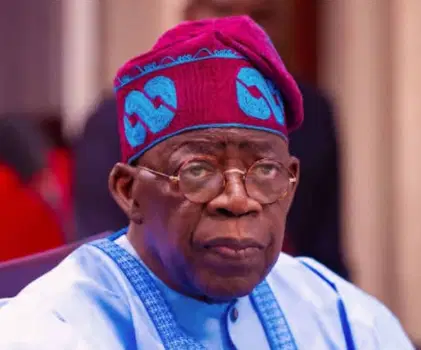
The Presidency has clarified that the legal proceedings involving President Bola Tinubu in a United States federal court are related to a request for the release of government records and do not amount to a criminal trial against him.
Sponsored Ads
The clarification was made by the Special Adviser to the President on Information and Strategy, Bayo Onanuga, who said the case was filed under the US Freedom of Information Act (FOIA). He stated that the court had neither convicted Tinubu of a crime nor declared him guilty of any criminal offence.
Sponsored Ads
The Presidency explained that the matter dates back to 2022, when Aaron Greenspan submitted FOIA requests to several US government agencies seeking records concerning Tinubu. After some of the agencies refused to release certain documents or declined to confirm whether such records existed, Greenspan filed a civil case before the United States District Court for the District of Columbia in 2023.
The court later allowed Tinubu to participate in the case as an intervenor, meaning he was permitted to take part in proceedings that could affect his interests.
According to the Presidency, some of the US agencies involved relied on what is known as the Glomar defence. The legal position allows government agencies to refuse to confirm or deny whether certain investigative records exist, particularly where revealing such information could expose law enforcement methods, sources or ongoing investigative interests.
The court subsequently granted summary judgment in favour of the Central Intelligence Agency, Executive Office for United States Attorneys, Department of State, Department of the Treasury and Internal Revenue Service. Those agencies were therefore removed from further proceedings in the case, while issues involving the Federal Bureau of Investigation and Drug Enforcement Administration remained under consideration.
The Presidency said the FBI and DEA eventually released 399 pages of documents in accordance with the court’s orders, although parts of the records were redacted because US law protects certain categories of information from public disclosure.
It explained that some of the withheld information related to grand jury proceedings, which are protected under US law. Other portions were covered by provisions protecting information concerning pen registers and trap-and-trace devices.
The government also said some documents contained material covered by attorney-client and attorney work-product privileges because they involved legal advice sought or received by FBI and DEA officials from lawyers within the US Department of Justice.
RELATED STORIES
Related Posts
The Presidency also referred to a 2003 communication from the US Consulate in Lagos to the then Inspector-General of Police, Tafa Balogun. According to the government, the letter stated that an FBI records check at the time did not find criminal arrest records, outstanding warrants or similar records involving Tinubu, who was then governor of Lagos State.
Meanwhile, the development has attracted fresh political criticism from the presidential candidate of the African Democratic Congress, Atiku Abubakar.
Atiku accused the Tinubu administration of considering a return to fuel subsidy ahead of the 2027 general election. He claimed the government was preparing to introduce some form of subsidy through domestic refining after spending years defending the removal of petrol subsidy.
Atiku made the allegation through his Senior Special Assistant on Public Communication, Phrank Shaibu. He argued that any intervention designed to reduce petrol prices should be linked to domestic production rather than the import-based subsidy system that existed previously.
The former vice president also welcomed a recent call by the Independent Petroleum Marketers Association of Nigeria for government action to encourage domestic refiners to reduce petrol prices.
Atiku said lower fuel prices could be achieved through policies that support local refining and make petroleum products more affordable for Nigerians. He argued that this approach would be different from the previous subsidy system because it would be connected to locally produced petroleum rather than imported fuel.
He also criticised the economic impact of high petrol prices, saying the cost affects transportation, food distribution and the purchasing power of households. According to him, expensive fuel places additional pressure on businesses and consumers because increased transportation costs are eventually reflected in the prices of goods and services.
Atiku called on petroleum marketers to support his proposed approach to the sector and participate in efforts to reduce the cost of energy if his political camp takes power in 2027.
He further challenged Tinubu to either reconsider policies that have increased living costs or face voters at the next presidential election. Atiku maintained that Nigerians would judge the administration based on the economic conditions they experience before the election.
The ADC candidate said his proposed energy policy would focus on improving domestic refining capacity and making petroleum products more affordable, while accusing the Tinubu administration of failing to adequately cushion the effects of the subsidy removal.

Comments are closed.