

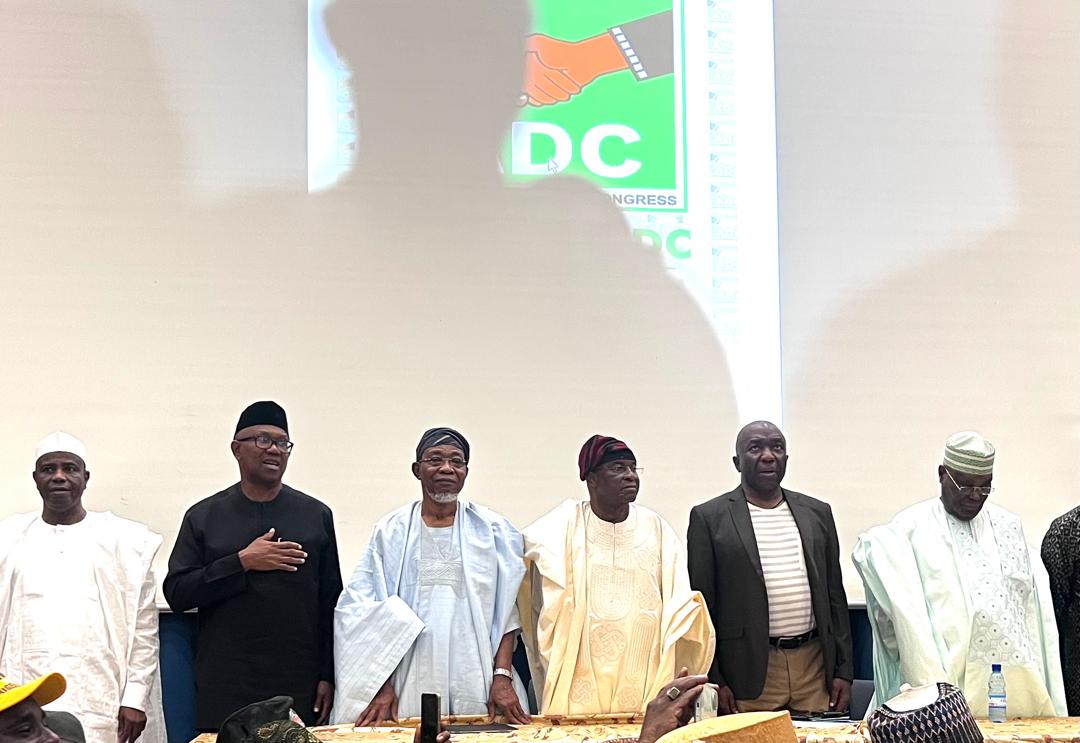
Months after its grand entry into Nigeria’s political scene, the African Democratic Congress (ADC) coalition — formed by leading opposition figures — is already facing questions about its strength and unity.
Sponsored Ads
Launched in July with promises to challenge the ruling All Progressives Congress (APC) and end one-party dominance, the coalition brought together big names like Peter Obi, Atiku Abubakar, David Mark, Nasir el-Rufai, and Rotimi Amaechi. It was hailed as a turning point for Nigeria’s opposition, following their fragmented performance in the 2023 elections that paved the way for President Bola Tinubu’s victory.
Sponsored Ads
However, its early performance at the polls has been disappointing. During by-elections held in August 2025, the ADC-led coalition failed to win a single seat. The poor outing was repeated in last weekend’s Anambra governorship election, where the ADC placed fifth with 8,208 votes. The All Progressives Grand Alliance (APGA) swept the poll with 422,664 votes, followed by the APC, YPP, and Labour Party (LP).
RELATED STORIES
Related Posts
Atiku Abubakar had endorsed the ADC candidate, John Nwosu, ahead of the election, describing it as a “unique opportunity” for Anambra voters to end poor governance. His appeal, however, failed to change the outcome.
Before the coalition adopted the ADC platform, the party had little national influence, holding just two seats in the House of Representatives. After the July merger, Ralph Nwosu’s leadership stepped aside for a transitional team led by former Senate President David Mark. Peter Obi also reaffirmed his commitment to the new alliance, calling it a step toward producing capable and compassionate leadership in 2027.
Atiku has remained active on social media, urging Nigerians to see the ADC as a vehicle for “rescuing Nigeria” from the Tinubu-led APC, which he accuses of causing insecurity, poverty, and hardship.
Despite the initial momentum, the coalition’s recent setbacks show that national endorsements and prominent names are not enough to sway state-level elections. Political observers say the poor start does not necessarily mean the coalition’s 2027 prospects are over — but it signals a need for stronger grassroots mobilisation and clearer coordination before the next general elections.

Comments are closed.