

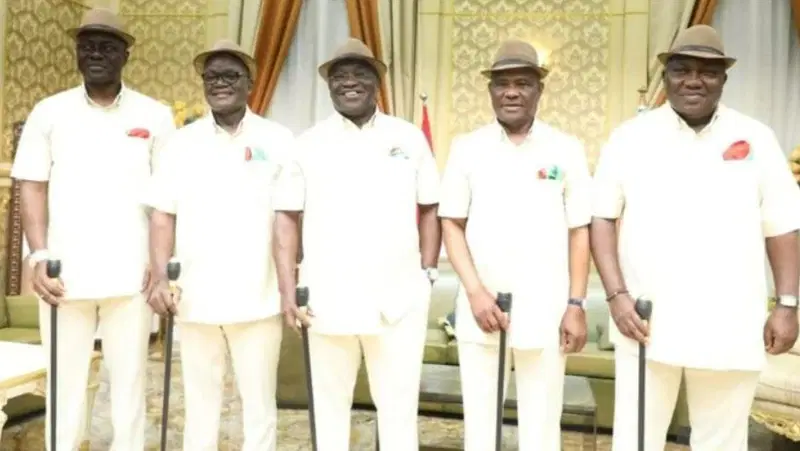
Former Benue State Governor Samuel Ortom has explained why he and four other governors known as the G5 turned their backs on the Peoples Democratic Party during the 2023 presidential election.
Sponsored Ads
Ortom said the group felt let down by the PDP’s handling of power rotation, accusing the party of ignoring a long-standing agreement on zoning between North and South.
Sponsored Ads
The fallout began when the PDP selected former Vice President Atiku Abubakar, a Northerner, as its presidential candidate, despite growing calls within the party to shift power to the South. Ortom, who led the PDP’s zoning committee at the time, said although the committee’s report allowed for an open contest, many within the party had expected the presidency to move South after eight years of Muhammadu Buhari’s administration.
Ortom said the G5 had made it clear that they wanted the party to respect fairness by allowing a southern candidate to emerge. According to him, the group had thrown their support behind former Rivers State Governor Nyesom Wike, first as a potential presidential candidate and later as a vice-presidential pick. Ortom said a committee tasked with recommending a running mate had a clear majority in favour of Wike, but their suggestion was ignored by the party leadership.
As the election drew closer, members of the G5 made different choices. Some backed Labour Party’s Peter Obi while others supported Bola Tinubu of the All Progressives Congress. Ortom defended this, saying political decisions often come down to personal and regional interests. He said leaders have a duty to protect the interests of their people, and that alliances are shaped by evolving political realities.
RELATED STORIES
Related Posts
His actions and that of other G5 members drew criticism within the PDP. Some accused them of betraying the party. Ortom dismissed the backlash, arguing that others in the PDP also worked against the party’s candidate. He insisted that the G5’s decision was a political strategy, and not an attempt to destroy the PDP.
The PDP, however, said the rebellion was selfish and not about justice or fairness. A member of the party’s National Working Committee who spoke anonymously said Ortom’s position was questionable, especially since he had once supported Senator Iyorchia Ayu, who is from the same local government area as Ortom, for national chairman. The source added that Ortom only raised concerns after Atiku secured the presidential ticket.
Atiku’s camp also fired back. In a response through his media aide, Atiku described the G5 as a group of frustrated politicians who acted out of self-interest. He said the process that led to his emergence followed due procedure and had the full backing of the party’s top decision-making body.
As the party looks ahead to 2027, the PDP is planning to zone the presidential ticket to the South. Party leaders are now questioning whether Ortom and his allies will return to support the PDP or continue backing the current APC-led government.
Meanwhile, former PDP presidential aspirant Dele Momodu has officially quit the party. In a letter addressed to his ward chairman in Edo State, Momodu said the PDP has been hijacked by undemocratic forces. He announced his move to the African Democratic Congress (ADC), joining what he described as a growing movement of former PDP members seeking a fresh political platform.
Momodu’s departure adds to the wave of defections that have hit the PDP in recent months, as internal divisions continue to weaken the party’s foundation ahead of future elections.

Comments are closed.