

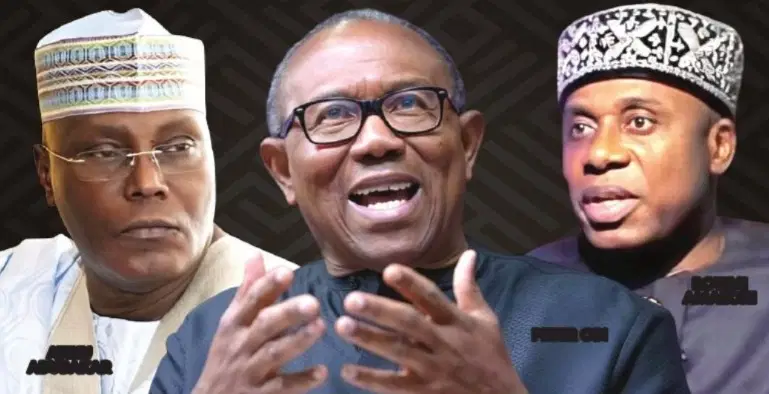
A political storm is brewing within the newly formed opposition coalition now operating under the African Democratic Congress (ADC).
Sponsored Ads
Top figures like Peter Obi, Atiku Abubakar, and Rotimi Amaechi have all shown interest in contesting the 2027 presidential election, raising questions about unity, ambition, and direction within the group.
Sponsored Ads
The growing tension stems from uncertainty over who will step aside for the other. As these three political heavyweights position themselves for the party’s ticket, many are asking how the coalition plans to manage the clash of ambitions without tearing itself apart before the real contest begins. All three individuals bring political experience and large followings, but no clear process has been defined to choose a single candidate.

LIST OF APPLICATIONS FOR REGULARISATION OF AREA COUNCIL LAND DOCUMENTS NULLIFIED/CANCELLED BY THE HONOURABLE MINISTER OF FCT
The coalition came into existence after months of internal wrangling within the People’s Democratic Party (PDP) and discontent among other opposition figures. Many of its members are former allies or rivals who have clashed in the past. The idea was to present a strong front against the ruling All Progressives Congress (APC) in 2027. But now, with several potential candidates jostling for the top position, the alliance faces early tests of unity and strategy.
The situation is further complicated by regional power dynamics. Both Obi and Amaechi have said they would serve just one term if elected, in line with the popular view that the South should retain power until 2031. This puts pressure on Atiku, a northern politician, to reconsider his ambition. While no decision has been made, the lack of internal mechanisms to manage such conflicts is already causing unease among members and supporters.
RELATED STORIES
Related Posts
Observers believe the coalition is yet to find its feet beyond elite political meetings. While press releases and high-profile announcements have created noise, there’s little evidence of groundwork at the grassroots. Many believe the coalition is still too focused on high-level deals in Abuja and not enough on building solid support across local communities. The lack of a shared vision and strategy is already affecting public confidence in its ability to challenge the APC.
Political experts warn that the coalition may suffer the same fate as the opposition in the 2023 election if it fails to organize properly. There’s concern that without a clear policy direction, defined roles, and real unity, the group will end up fragmented by the time election season fully begins. They point to the mistakes of relying too much on online popularity without on-the-ground mobilisation, especially referencing the performance of the Obidient Movement during the last elections.
Peter Obi remains very popular nationwide, but critics say the movement around him is not well-structured. Many young supporters rally online, but physical presence at polling units, trained agents, and ground operations remain weak. Others in the coalition, including Amaechi and Atiku, have traditional political machinery but may struggle to work together if the current disarray continues.
In the middle of these developments, speculations are growing that more PDP governors could defect, including Governor Peter Mbah of Enugu State. Some insiders say his possible move to the APC would deal another blow to the already weakened PDP. The PDP itself has just reinstated Senator Samuel Anyanwu as National Secretary, but that decision has stirred anger in the South-East, further deepening internal cracks.
The battle for the 2027 presidency has clearly started early. The ADC coalition will need to act fast, not just in choosing a flag bearer, but in proving that it can hold together and offer Nigerians something different. Without that, the alliance risks collapsing under the weight of its own ambitions.

Comments are closed.