

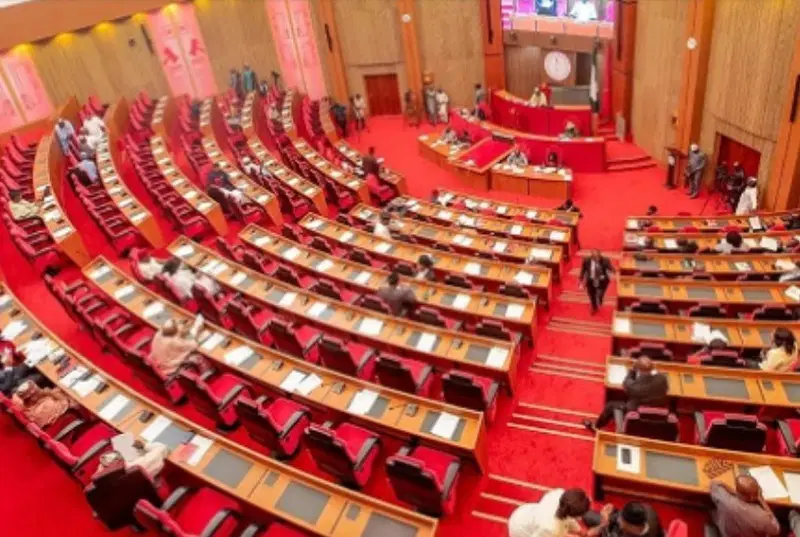
The Senate has taken another step towards requiring global social media companies operating in Nigeria to establish physical offices in the country, following strong support for the proposal during a public hearing held in Abuja on Thursday.
Sponsored Ads
The hearing, organised by the Senate Committee on Information and Communications Technology and Cyber Security, also attracted support for a separate bill seeking to establish an Artificial Intelligence Academy in Omuo-Ekiti, Ekiti State.
Sponsored Ads
The bill seeking to compel social media companies to open offices in Nigeria was sponsored by Senator Ned Nwoko, who represents Delta North Senatorial District. It proposes an amendment to the Nigeria Data Protection Act, 2023, to make it compulsory for social media platforms operating in the country to maintain physical offices within Nigeria.
The separate bill on the proposed Artificial Intelligence Academy was sponsored by the Chairman of the Senate Committee on Media and Publicity, Senator Yemi Adaramodu, who represents Ekiti South Senatorial District.
Speaking at the opening of the hearing, Chairman of the Senate Committee on ICT and Cyber Security, Senator Shuaib Salisu of Ogun Central, said both bills were designed to strengthen Nigeria’s digital economy and expand the country’s technological capacity.
He explained that while the social media bill is intended to improve the regulation and protection of Nigeria’s digital space, the proposed academy would provide a dedicated centre for artificial intelligence education, research and innovation.
President of the Senate, Godswill Akpabio, who was represented by Deputy Senate Leader, Senator Lola Ashiru, described both proposals as timely and beneficial to the country’s technological development.
According to him, the bill requiring social media companies to establish offices in Nigeria is not aimed at restricting their activities but at promoting greater accountability and improving their relationship with the country.
RELATED STORIES
Related Posts
Defending the bill, Senator Nwoko dismissed claims that the proposed legislation could discourage foreign investment or target technology companies.
He said the objective of the bill is to encourage global technology firms to become more established in Nigeria and participate more actively in the country’s economic and digital development.
The senator noted that many countries with smaller populations and digital markets than Nigeria have successfully attracted major technology companies to establish headquarters, regional offices and operational centres.
He listed countries such as the United Kingdom, the Netherlands, Spain, Singapore, India, the United Arab Emirates, South Africa, Brazil, Australia and Japan as examples where global technology companies have established strong local operations.
Nwoko explained that these offices carry out various responsibilities, including engineering, artificial intelligence research, legal and regulatory compliance, public policy, advertising, trust and safety, cloud services, sales, customer support and product development.
According to him, those countries deliberately created an environment that encouraged technology companies to invest locally, leading to increased employment opportunities, higher tax revenues, stronger engagement with regulators and the transfer of technological knowledge to their citizens.
He also pointed to Ireland as an example, saying the presence of companies such as Meta, Google, LinkedIn, TikTok and X had helped transform the country into one of Europe’s leading technology centres by attracting investment, creating jobs and supporting innovation.
Nwoko argued that Nigeria, as Africa’s largest digital market, should also enjoy similar economic and technological benefits instead of remaining on the sidelines while other countries continue to attract major technology investments.
The Senate committee is expected to examine memoranda submitted by stakeholders before preparing its report for consideration by the Senate as the legislative process continues.

Comments are closed.