

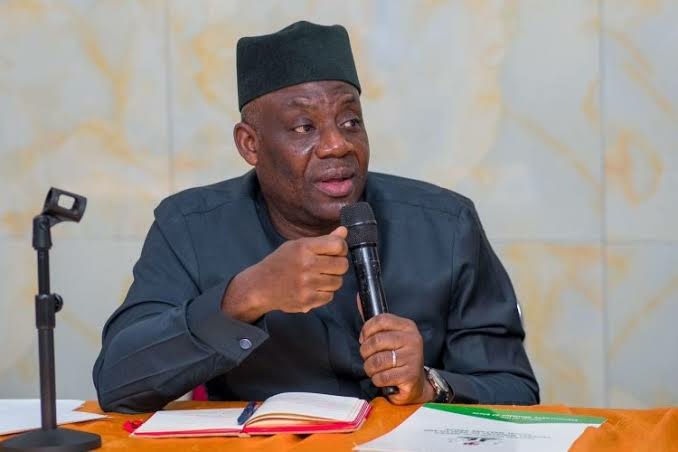
The Federal Government has asked the National Assembly to suspend the establishment of new federal universities, polytechnics and colleges of education for seven years, citing funding challenges, infrastructure deficits and declining standards in existing institutions.
Sponsored Ads
The Minister of Education, Dr Tunji Alausa, made the appeal in a November 2, 2026, memorandum addressed to the Senate President, Godswill Akpabio, and copied to the Senate Majority Leader, Senator Michael Opeyemi Bamidele.
Sponsored Ads
In the memo, Alausa urged lawmakers to stop considering and passing bills seeking to establish additional federal tertiary institutions during the proposed moratorium.
He disclosed that the Federal Executive Council had approved the seven-year suspension at its meeting on August 13, 2025, as part of efforts to address the proliferation of public tertiary institutions, duplication of academic programmes and underutilisation of existing facilities.
The minister argued that Nigeria’s immediate challenge was not the creation of more institutions but the improvement of existing universities, polytechnics and colleges of education to ensure quality education.
He warned that establishing additional institutions without adequate funding would further stretch government resources and worsen the challenges confronting the tertiary education sector.
According to him, many existing institutions are struggling with inadequate lecture halls, overcrowded classrooms, poorly equipped laboratories, shortages of qualified academic personnel, insufficient accommodation and deteriorating infrastructure.
Alausa acknowledged the constitutional powers of the National Assembly to enact laws establishing tertiary institutions but urged lawmakers to consider national needs and the long-term financial implications of such legislation.
He maintained that the proposed moratorium would enable the government to consolidate previous investments, address existing deficiencies and improve the capacity of operational institutions before considering further expansion.
To support his position, the minister disclosed that the Federal Government had outstanding financial commitments of N1.3 trillion under its 2013–2018 revitalisation agreement with the Academic Staff Union of Universities (ASUU).
RELATED STORIES
Related Posts
He said only N250 billion of the pledged amount was released between 2013 and 2021.
Alausa also revealed that out of the additional N150 billion approved in 2025 for Needs Assessment Intervention, only N50 billion was initially released.
He argued that the funding gaps raised concerns about the government’s ability to sustain additional institutions while struggling to meet existing financial obligations.
The education minister also cited the experiences of Ekiti and Imo states, where the establishment of multiple tertiary institutions reportedly created financial and administrative difficulties.
He recalled that three state-owned universities in Ekiti were consolidated into one institution, Ekiti State University, Ado-Ekiti, in 2011.
He further noted that Imo State had undertaken institutional reviews and integration following the establishment of several tertiary institutions under previous administrations.
According to him, some state governments had also approached the Federal Government seeking to transfer ownership of their universities because of difficulties financing their operations.
Alausa warned that institutions established without sustainable funding arrangements could become financial liabilities, forcing subsequent administrations to undertake costly mergers, restructuring or closures.
He also referenced Australia, Finland, Japan, the United States and South Africa, noting that some institutions in these countries had adopted mergers and consolidation to address funding constraints, duplication of programmes and administrative inefficiencies.
The minister said such reforms had helped strengthen institutional governance, improve research capacity and promote more efficient utilisation of public resources.
He maintained that Nigeria needed to prioritise institutional viability, academic standards and effective resource management rather than continue establishing new federal tertiary institutions.

Comments are closed.