

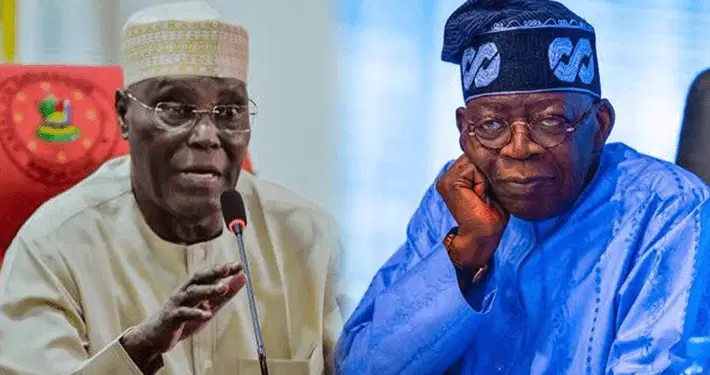
More than $10 million reportedly committed by the camps of President Bola Tinubu and former Vice President Atiku Abubakar to lobbying activities in the United States has triggered fresh debate over how such funds could have been used to address economic challenges in Nigeria.
Sponsored Ads
Documents filed under the United States Foreign Agents Registration Act (FARA) reportedly put the combined value of the two engagements at about $10.2 million.
Sponsored Ads
Using an exchange rate of N1,400 to the dollar, the amount is approximately N14.28 billion.
The figure has prompted comparisons with possible investments in small businesses, education and other areas where Nigerians continue to face financial difficulties.
For instance, dividing N14 billion into packages of N250,000 would produce about 56,000 interventions. At N500,000 each, the same amount could support about 28,000 beneficiaries, while N1 million allocations would cover about 14,000 businesses.
These calculations are only illustrations and do not mean that the funds would automatically create the stated number of successful businesses. The outcome would depend on the financing model, administration costs, business sectors, survival rates and other factors.
The Federal Government’s engagement with Washington-based DCI Group reportedly began in December 2025. The firm was hired to assist Nigeria with communication with US policymakers, particularly on issues relating to the protection of Christian communities and continued American support for Nigeria’s counter-terrorism efforts.
The agreement reportedly provided for a monthly payment of $750,000. The initial six-month contract was valued at $4.5 million, with an option for automatic renewal that could raise the total value to $9 million. Nigeria reportedly paid $4.5 million upfront for the first six months.
The engagement came amid increased attention in Washington to Nigeria’s security situation and its international image. Its supporters could therefore argue that the spending had diplomatic and security objectives beyond direct financial returns.
Atiku, meanwhile, reportedly engaged Von Batten-Montague-York, L.C., a Washington-based lobbying firm, under a $1.2 million agreement lasting 12 months.
Documents submitted to the US Department of Justice indicated that the engagement was aimed partly at improving Atiku’s access to US policymakers and challenging narratives associated with the Nigerian government.
The agreement also reportedly covered efforts to facilitate meetings with members of Congress and officials in the executive branch, alongside strategic advice on policy matters.
In July, reports emerged that the firm had circulated historical US Department of Justice records concerning a 1993 drug-trafficking asset-forfeiture case linked to Tinubu. More than 60 pages of documents were reportedly sent to members of the Trump administration, Congress and senior congressional staff.
The combined value of the reported engagements is about $10.2 million, which translates to roughly N14.28 billion at N1,400 to the dollar.
The comparison with domestic investment has gained attention because Nigerian micro, small and medium enterprises remain major contributors to economic activity but continue to face difficulties accessing finance.
The World Bank has previously described MSMEs as accounting for most businesses and a large share of employment and economic activity in Nigeria, while noting limited access to formal credit among them. It also approved a $500 million financing package aimed at improving access to finance for Nigerian MSMEs.
RELATED STORIES
Related Posts
Education is another area where the same amount could have provided support.
Based on the fee figures cited for Lagos State University, N14 billion could cover annual tuition for about 155,555 regular students paying N90,000 each. At N190,000, the amount could cover fees for about 73,684 students.
Using the N20,000 monthly upkeep allowance under the Nigerian Education Loan Fund, the same amount could provide one month’s allowance to about 700,000 students.
At Olabisi Onabanjo University, where the cited tuition ranges from N190,000 to N350,000, the funds could theoretically cover the fees of between about 40,000 and 73,684 students, depending on the applicable fee.
The calculations also show that combining tuition payments with the monthly allowance would reduce the number of students who could benefit.
Labour data cited in the report further shows the importance of self-employment and small businesses to Nigerians’ livelihoods. About 66.9 per cent of respondents in the referenced sample reported working in their own businesses or farming activities, while 20.2 per cent said they assisted in household businesses.
An economic expert who spoke anonymously questioned whether spending such a large amount on lobbying was the best use of resources at a time when Nigerians are dealing with economic difficulties.
The expert argued that domestic needs, including infrastructure and basic services, remain extensive and questioned the practice of taking political disputes to foreign governments and institutions.
Executive Director of the Rule of Law and Accountability Advocacy Centre, RULAAC, Okechukwu Nwanguma, also focused on the issue of opportunity cost.
He argued that where public funds are involved, government should be able to explain who received the money, how much was paid, the purpose of the expenditure, the procurement process and the expected results.
Nwanguma, however, distinguished between Atiku’s reported spending and the Federal Government’s engagement. He noted that a politician using legitimately acquired private funds for lobbying raises questions about disclosure and compliance, while the use of taxpayers’ money requires a higher level of accountability.
There is also an argument that lobbying can generate benefits that cannot immediately be measured in terms of businesses or infrastructure projects.
For the Federal Government, lobbying in Washington could potentially support diplomatic relations, security cooperation and access to US policymakers. Atiku’s engagement, on the other hand, is primarily political and reputational in nature.
The central question is therefore whether the expected benefits from the lobbying activities justify the money committed to them, particularly when Nigeria faces urgent needs in areas such as job creation, education, electricity, healthcare and infrastructure.
Financial Derivatives Company Managing Director, Bismarck Rewane, has previously pointed to productivity and the operating environment for businesses as important to Nigeria’s economic prospects.
The report noted that sectors such as power, agriculture, manufacturing, fintech and telecommunications could contribute to higher productivity, while unreliable electricity and high operating costs continue to affect small businesses.
The debate over the reported $10.2 million spending therefore extends beyond whether lobbying is useful. It also raises questions about how political and public resources should be allocated and what measurable returns Nigerians should expect from such expenditure.

Comments are closed.