

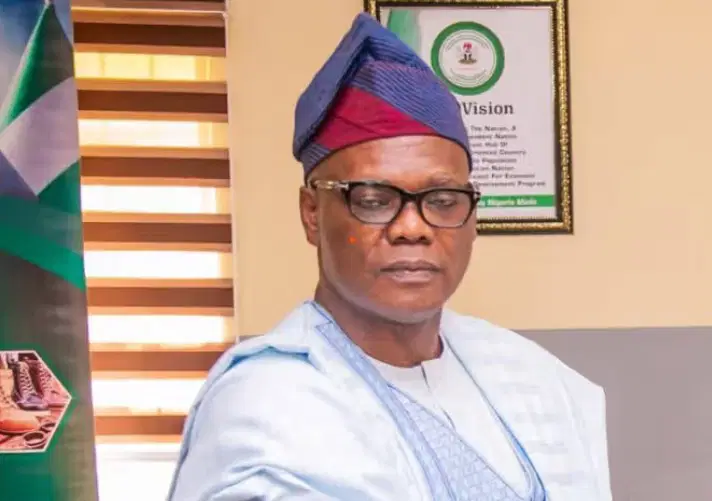
The National Coordinator and Executive Director of the Made-in-Nigeria Project Office, Nwabueze Buchi George, has defended the existence of his organisation amid growing questions over its legal status and operations.
Sponsored Ads
George, whose office is being scrutinised following investigations by the Independent Corrupt Practices and Other Related Offences Commission, dismissed suggestions that the programme was recently created or unknown to government authorities.
Sponsored Ads
In a post on LinkedIn, George argued that the programme had been in existence for 16 years and questioned why people were only becoming aware of it in 2026.
The controversy surrounding the office comes amid the ICPC’s investigation into an alleged fraudulent federal agency operating under a similar name.
George had previously traced the origin of his organisation to an initiative dated June 15, 2010. He also shared a letter from the Office of the Secretary to the Government of the Federation dated July 19, 2010, which he presented as part of the history of the programme.
However, the document was addressed to “Buchi George” of The Hats Centre in Owerri, Imo State, and related to the endorsement of a project called “Made In Naija” for an event in Ireland.
The document did not, on its face, establish the existence of a federal agency responsible for brand development under the name currently being used by George’s office.
There is also a discrepancy between George’s claim that the programme has operated continuously for 16 years and an appointment letter dated October 3, 2025.
The letter from the Office of the Secretary to the Government of the Federation formally conveyed George’s appointment as National Coordinator and Executive Director of the Made in Nigeria Project Office for a five-year tenure beginning in July 2025.
Materials circulated by the organisation describe its activities as efforts to promote local production under an “Industrialise Nigeria” campaign.
Despite the controversy, officials of the Office of the Secretary to the Government of the Federation have not publicly clarified the legal status, funding arrangement or administrative structure of the organisation.
Efforts to obtain the position of the OSGF on the matter were unsuccessful. The Special Adviser on Media and Publicity to the Secretary to the Government of the Federation, Yomi Odunuga, did not respond to enquiries, while the Head of Information and Public Relations at the OSGF, Chris Ugbuegbulam, was reportedly unreachable.
The lack of an official explanation has left questions about the office’s status and relationship with the Presidency unanswered.
Meanwhile, the organisation’s website lists 20 state coordinators from states including Kogi, Bauchi, Oyo, Taraba, Kano, Ondo, Benue, Nasarawa, Plateau, Kaduna, Katsina, Niger, Zamfara, Abia, Sokoto, Ogun, Anambra, Osun, Kebbi and Delta.
The Secretary to the Anambra State Government, Chiamaka Nnake, has also explained her connection with the organisation after her photograph appeared among the state representatives linked to the office.
Nnake said her involvement was limited to official communications concerning plans for a Made-in-Nigeria fair in Anambra State.
According to her, the Anambra State Government received a letter in January 2026 from the Made-in-Nigeria Office, which was presented as an office under the OSGF.
The letter requested that the state nominate a focal person, after which Governor Chukwuma Soludo nominated Nnake for the role in February.
She said representatives nominated from the 36 states were subsequently added to a WhatsApp group where they discussed activities associated with the office.
Nnake added that the organisation later approached the Anambra State Government with a request to host the South-East Made-in-Nigeria Fair.
RELATED STORIES
Related Posts
The request was approved and an inaugural planning meeting was held about two weeks ago, with George in attendance.
She said preparations for the event were ongoing and that the fair was scheduled to take place from December 2 to 5, 2026.
However, Nnake stressed that her involvement went no further than those official engagements.
She said she had no knowledge of, participation in or connection with any other activities or claims attributed to the organisation.
A former Permanent Secretary of the Federal Civil Service Commission, Goke Adeboroye, has meanwhile blamed weaknesses within Nigeria’s government bureaucracy for allowing an alleged fake presidential agency to operate.
Adeboroye spoke during an interview on Channels Television’s Inside Sources following the ICPC’s discovery of an alleged Presidential Foreign Intervention Promotion Council.
The anti-corruption agency had alleged that the organisation operated using forged appointment letters and other official documents.
Adeboroye said the development exposed serious weaknesses in the government’s internal control systems.
He questioned how an individual could allegedly gain access to government structures, secure appointments, obtain budgetary provisions and operate from office premises without the irregularities being detected earlier.
The former permanent secretary said several key offices within the Presidency, including the OSGF, the Office of the Chief of Staff to the President and the Office of the Head of the Civil Service, require strong bureaucratic structures capable of supporting government policies while preventing fraudulent instructions from being implemented.
He said career civil servants should have enough experience and professional independence to question directives that do not follow established government procedures.
Adeboroye argued that officials familiar with government operations should be able to identify questionable documents purportedly originating from the Presidency.
He explained that presidential approvals typically pass through established channels involving senior government officials, including the Chief of Staff, the Secretary to the Government of the Federation and, where necessary, the Head of the Civil Service.
He said these procedures provide opportunities for officials to verify questionable communications before acting on them.
Adeboroye recalled an incident from his time as Permanent Secretary in the Ministry of Interior involving a former governor who claimed to have obtained presidential approval for a diplomatic passport.
According to him, the then Comptroller-General of the Nigeria Immigration Service, Ude, did not immediately act on the request. Instead, the official verified the purported presidential approval and subsequently sought clarification on whether the former governor, who was no longer in office, should receive a diplomatic passport.
Adeboroye said the incident demonstrated how experience, institutional knowledge and proper verification procedures could prevent government officials from acting on fraudulent or inappropriate directives.
He added that questionable instructions could often be verified through direct communication with the relevant government offices.
The former permanent secretary said strengthening the bureaucracy and improving the ability of career officials to verify government communications would help prevent similar controversies in the future.

Comments are closed.