

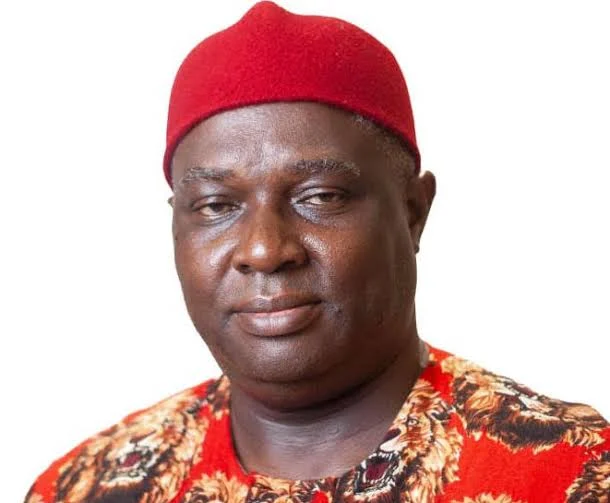
The African Democratic Congress governorship candidate in Enugu State, Obodoeze Ocho, has denied reports of a political alliance with the All Progressives Congress, insisting that he has no agreement or working relationship with the ruling party.
Sponsored Ads
Sponsored Ads
Ocho made the clarification on Thursday during his maiden media briefing in Enugu, where he presented key proposals in his 2027–2031 State Transformation Blueprint.
The document, titled “The Foundation of Redefined Governance: Security That Responds, Agriculture That Creates Wealth, Government That Is Open”, outlines his proposed approach to security, agriculture, taxation, industrial development and public accountability.
On security, the ADC candidate criticised the state government’s existing approach, arguing that technology alone had not adequately addressed insecurity. He questioned the whereabouts of drones reportedly acquired by the government and said surveillance facilities were concentrated mainly in the state capital, leaving vulnerable communities exposed.
Although he acknowledged the establishment of a Command and Control Centre and the installation of CCTV cameras, Ocho argued that security operations needed to be more responsive to local communities.
He promised to establish an Integrated Security Control Centre equipped with high-definition CCTV cameras in identified security hotspots, including Uzo-Uwani, Isi-Uzo, Aninri, Ezeagu and Ugwuogo Road. The proposed facility would be connected to rapid response teams.
He also pledged to establish Neighbourhood Watch and Community Response Teams across all 17 local government areas, introduce welfare and insurance support for security personnel, and work with telecommunications companies to improve network coverage in underserved communities.
Ocho said farmers should be able to work on their land without fear of attacks, referring to recent killings of farmers in Uzo-Uwani allegedly involving suspected Fulani herdsmen.
On agriculture, he argued that the sector had not been sufficiently organised to generate wealth for farmers, leaving many unable to preserve or process their produce after harvest.
He proposed establishing an Agricultural Institute and an agricultural campus of Enugu State University of Science and Technology in Uzo-Uwani. He also outlined plans for a cooperative-based farming system, a food bank to purchase surplus produce and the revival of the Agricultural Marketing Board, Food Bank, Storage Board and Processing Board.
RELATED STORIES
Related Posts
The candidate said agro-processing clusters would be developed to convert cassava, yam, rice and vegetables into finished products, while private-sector partnerships would be encouraged to revive the state’s coal and mineral resources.
He further pledged to promote industrial parks and manufacturing as part of efforts to expand economic opportunities in the state.
Ocho also questioned the growth of Enugu’s internally generated revenue, arguing that the state needed to explain how it was increasing collections despite lacking a seaport, oil boom or large industrial base.
He suggested that the burden could be falling disproportionately on ordinary residents, including market women, tricycle operators, shop owners and artisans.
To address this, he promised a Tax Justice System that would reduce taxes for low-income earners in rural communities by 50 per cent. He also proposed a digital tax receipt system based on a one-tax, one-receipt policy, arguing that government revenue should increase through digitalisation rather than excessive levies on small businesses.
The ADC candidate equally raised concerns about the transparency of public-private partnerships involving Enugu Air, Enugu International Hospital and Hotel Presidential. He alleged that some arrangements lacked sufficient public accountability and promised to subject such agreements to due diligence and public scrutiny if elected.
Addressing reports of an alliance with the APC, Ocho categorically denied any political understanding, agreement, secret meeting or working relationship with the party at any level.
He attributed the rumours to political opponents and maintained that his commitment remained with the ADC, its manifesto and the people of Enugu State.
On the controversy surrounding political zoning, Ocho argued that the arrangement had no constitutional basis, claiming that the PDP was the only party with zoning provisions in its constitution. He also questioned the consistency of the PDP’s application of the arrangement.
Regarding housing, he acknowledged the rising cost of accommodation in the state and said he had plans to provide affordable housing, although he declined to disclose the details during the briefing. He said he wanted to avoid making commitments that could not be fulfilled.
Ocho also criticised the state government’s land policies, alleging that its interest in certain areas had encouraged speculation and contributed to rising land prices. He said a review and restructuring of existing executive orders would form part of his proposed response.

Comments are closed.