

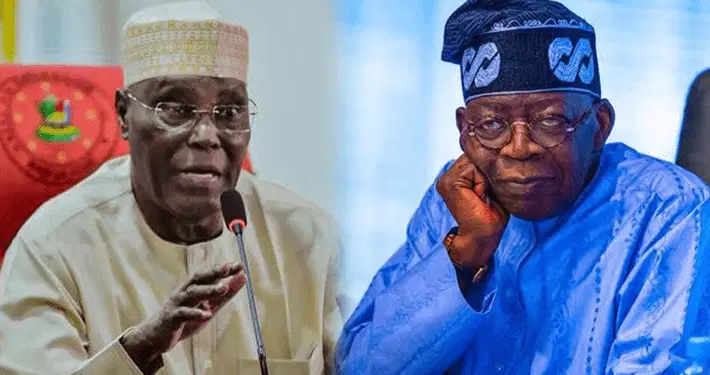
Former Vice President and presidential candidate of the African Democratic Congress (ADC), Atiku Abubakar, has accused President Bola Tinubu’s administration of failing to fulfil its campaign promise to provide Nigerians with steady electricity.
Sponsored Ads
Atiku alleged that the All Progressives Congress (APC) campaign council was attempting to divert attention from the government’s unfulfilled electricity pledge by focusing on legislation, committees, bonds and power projects.
Sponsored Ads
He made the remarks on Sunday through Phrank Shaibu, Director of Strategic Communications of the ADC Presidential Campaign Council, in response to comments by the Minister of Solid Minerals Development, Dele Alake, on the administration’s electricity sector reforms.
Atiku said Nigerians continued to contend with unreliable electricity supply, forcing households and businesses to spend scarce resources on alternative sources of power while still paying electricity bills.
He argued that despite the passage of three and a half years, families were still struggling to keep their homes lit, while traders and small business owners faced additional operating costs because of their dependence on generators and other alternatives.
The former vice-president also criticised the electricity band system, saying consumers across Bands A, B, C, D and E continued to experience power outages despite paying different tariffs.
He noted that customers in some areas classified under Band A paid about ₦209.50 per unit before Value Added Tax (VAT), while rates for other bands varied depending on the state and electricity distribution company.
According to Atiku, consumers across the different categories continued to face the same difficulties, with electricity supply remaining unreliable despite the varying charges.
He maintained that households should not have to choose between paying electricity bills and meeting their basic needs, while businesses should not be charged for electricity they do not receive.
On the planned removal of electricity subsidies from 2027, Atiku called on the Federal Government to clarify how the policy would affect consumers, despite assurances that there would be no immediate increase in electricity tariffs.
He questioned what would happen to electricity bills when the subsidy was eventually removed and demanded clear information on the implications for households and businesses.
RELATED STORIES
Related Posts
Atiku said he would work with state governments and regulators, within the provisions of the law, to replace the existing band system with what he described as a fair, transparent and affordable electricity pricing framework.
He added that the proposed framework would make electricity distribution companies more accountable for the power they supply to consumers.
The ADC chieftain also recalled Tinubu’s campaign promise during the 2022 presidential election, when the President reportedly pledged to provide constant electricity within four years.
Atiku argued that Nigerians had now lived through the period covered by that commitment and should not have to rely on explanations from the President’s campaign council.
He further questioned the administration’s investment in new electricity generation infrastructure, alleging that it had failed to establish a new generation facility capable of increasing the country’s power capacity.
The former vice-president made the allegation while referring to the Federal Government’s multitrillion-naira bond programme aimed at settling outstanding debts owed to power generation companies.
He argued that clearing existing debts was different from building new infrastructure to increase electricity generation, adding that bond financing could not replace the delivery of power to homes and businesses.
Atiku also raised concerns about the application of VAT on electricity and a provision in the Nigeria Tax Act for a five per cent surcharge on certain fossil fuels, including petrol and diesel.
He noted that the Federal Government had said the surcharge had not been activated and would require a ministerial order, but insisted that Nigerians deserved clarity on the possibility of additional energy-related charges.
Atiku maintained that legislative measures, bond issuance and project approvals could not substitute for reliable electricity supply, arguing that Nigerians needed power to cook, study, work and sustain businesses.
He urged the Tinubu administration to account for its campaign promises and provide answers on the performance of the electricity sector.

Comments are closed.