

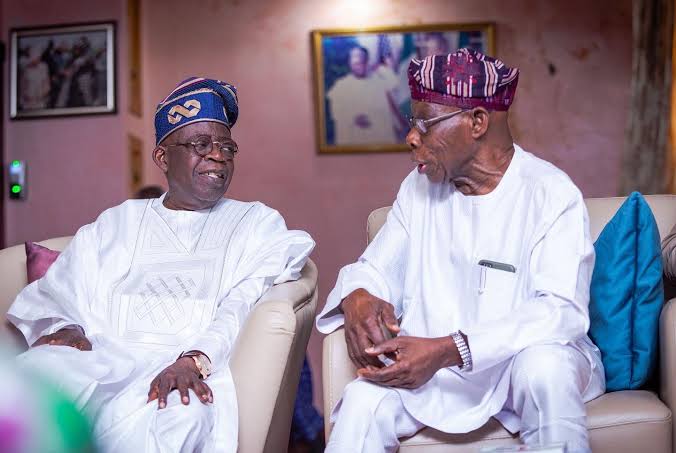
Former President Olusegun Obasanjo has criticised President Bola Tinubu’s position on government borrowing, arguing that excessive debt could mortgage Nigeria’s future and place a heavy burden on generations yet unborn.
Sponsored Ads
Obasanjo also warned that Africa could face a new form of colonialism through artificial intelligence (AI) if foreign companies and governments continued to control the technology, its infrastructure and the data generated across the continent.
Sponsored Ads
He made the remarks on Friday in Abeokuta, Ogun State, while speaking at the Ajibosin Platform, a public forum themed Leveraging Artificial Intelligence to Solve Grassroots Problems and Accelerate National Development.
Responding to Tinubu’s earlier statement that borrowing was not leprosy, Obasanjo argued that the consequences of accumulating public debt could extend beyond the present generation.
He maintained that while leprosy affects an individual, poorly managed national debt could affect several generations.
Tinubu had defended his administration’s borrowing policy in April, saying borrowing was not inherently wrong as long as the country had the capacity to repay its loans.
The President made the comment during a meeting with Plateau State leaders, including Governor Caleb Mutfwang and APC National Chairman, Prof. Nentawe Yilwatda, at the State House.
Tinubu’s position came amid public concerns over Nigeria’s rising debt profile and the growing share of government revenue used for debt servicing.
Obasanjo also questioned the country’s economic performance over the past 47 years, particularly the depreciation of the naira against the United States dollar.
Using his experience as a farmer to illustrate the decline, he recalled that the naira was stronger than the dollar when he established his farm 47 years ago.
He questioned what Nigeria had achieved economically over the period, considering that the exchange rate had fallen from about ₦1 to $1.85 to approximately ₦1,500 to the dollar.
The former president challenged political leaders to demonstrate their understanding of the country’s problems and present practical solutions to the challenges facing Nigerians.
He also criticised Nigeria’s dependence on the World Bank and International Monetary Fund (IMF), arguing that the institutions were established before many African countries gained independence and that their economic recommendations might not always reflect the continent’s specific needs.
Obasanjo urged Nigerian leaders to examine foreign economic policies carefully and ensure that decisions taken at home were guided by the country’s interests and development priorities.
Turning to artificial intelligence, he warned that Africa could repeat aspects of its colonial experience if it failed to establish control over the technology and its applications.
Although he admitted that he lacked extensive technical knowledge of AI, Obasanjo said ownership and control would determine whether the technology served African interests or was used against the continent.
He drew comparisons between the emerging technology and Africa’s experiences with slavery, colonialism and economic dependence, urging governments to approach the AI revolution with caution.
He also questioned the terms of technology transfer agreements between African countries and foreign providers, calling for greater scrutiny of who benefits from such arrangements.
Obasanjo further criticised what he described as unequal global economic policies, pointing to restrictions on agricultural subsidies in developing countries while farmers in wealthier nations continued to receive government support.
The former president also expressed concern over the estimated 24 million Nigerian children who are out of school, warning that their exclusion from education could create serious problems for the country in the future.
He urged policymakers and technology experts to explore ways artificial intelligence could improve access to education and address learning difficulties.
On agriculture, Obasanjo called for the use of AI to help farmers select suitable crops, increase productivity and improve food and nutrition security.
Also speaking at the event, historian Dr Umar Ardo warned that Africa could be entering another period of economic exploitation through artificial intelligence if it failed to secure ownership of its data, technological infrastructure and intellectual resources.
RELATED STORIES
Related Posts
In a presentation titled From Slave Ships to Server Farms: Artificial Intelligence and Africa’s Unbroken History of Extraction, Ardo said AI offered opportunities for economic development but could deepen existing inequalities if African countries remained dependent on foreign technology companies.
He argued that the continent needed to move beyond adopting innovations developed elsewhere and address questions of ownership, control, regulation and the distribution of economic benefits.
Ardo traced Africa’s economic history over five centuries, identifying the transatlantic slave trade, colonial exploitation of natural resources and post-independence economic dependence as major stages in the extraction of the continent’s wealth.
He explained that the slave trade treated African people as commodities, while colonial administrations focused on extracting mineral and agricultural resources for foreign markets. After independence, many African economies continued to depend on exporting raw materials and importing finished products.
According to him, much of the infrastructure introduced during colonial rule, including railways, steam engines and administrative systems, was designed primarily to facilitate the movement of African resources to overseas markets.
He also identified the migration of highly trained African professionals, including doctors, nurses, engineers and scientists, to other countries as another source of resource loss for the continent.
Ardo warned that data could become the next major commodity extracted from Africa, noting that information generated by citizens, hospitals, farmers, businesses, indigenous communities and public institutions was increasingly valuable to the global digital economy.
He expressed concern that the infrastructure used to process data, develop AI models and generate intellectual property and commercial profits remained largely controlled by interests outside Africa.
He questioned who owned and benefited from information about farmers’ agricultural practices, patients’ medical records, indigenous languages, traditional medicine and cultural knowledge when such data was incorporated into AI systems developed by foreign companies.
To prevent AI from becoming another source of economic dependence, Ardo proposed a framework based on technological sovereignty, data protection, indigenous innovation, grassroots development and cooperation among African countries.
He called for stronger laws and institutions to prevent the uncontrolled use of personal information and traditional knowledge.
Although he acknowledged the Nigeria Data Protection Act 2023 as an important measure for protecting citizens’ information, he argued that privacy safeguards alone would not guarantee data sovereignty.
He advocated additional protections for community knowledge, including fair compensation and mechanisms to ensure Africans receive a reasonable share of the commercial value generated from their data and intellectual resources.
Ardo also urged the Federal Government to invest more in domestic computing infrastructure, reliable electricity, semiconductor technology, research institutions and locally developed AI systems.
He argued that Nigeria, with a population of more than 230 million, should not remain only a market for foreign technology.
The historian called for locally controlled datasets and AI models capable of understanding African languages, farming practices, medicinal traditions and customary knowledge, with ownership and safeguards remaining in African hands.
On grassroots development, he urged governments to apply AI in areas such as primary healthcare, agricultural extension services, local government administration, revenue collection, conflict resolution and disaster management.
He also called for comprehensive AI training programmes in universities, polytechnics and colleges of education to produce software developers, technicians, data managers and other skilled professionals.
Ardo further urged Nigeria to work with other African countries to harmonise data governance regulations, establish shared technological infrastructure and improve the continent’s negotiating position when dealing with international technology companies.
He identified the African Union’s Data Policy Framework, adopted in 2022, as a foundation for coordinated action across the continent.
Warning that digital exploitation could be more difficult to detect than the extraction of physical resources, he said personal and community information could cross national borders without the knowledge or meaningful consent of those who generated it.
Ardo urged African leaders to learn from the continent’s history and ensure that it became a developer, owner and regulator of emerging technologies rather than remaining dependent on foreign innovations.
He maintained that Africa still had the opportunity to determine how artificial intelligence would shape its future, adding that the technology could either reinforce existing dependence or become a tool for the continent to take greater control of its development.

Comments are closed.