

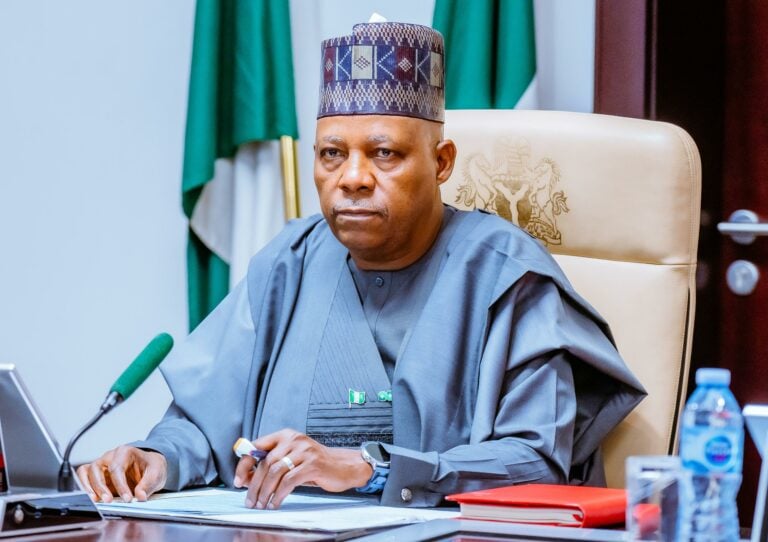
Vice President Kashim Shettima has called for unity in tackling Nigeria’s security problems, saying bombs and bullets do not discriminate by religion, ethnicity, or social status.
Sponsored Ads
Speaking in Abuja at a high-level stakeholders’ meeting on regional development organised by the National Counter Terrorism Centre, he warned that violence threatens everyone equally and must be met with a collective response.
Sponsored Ads
Represented by the Deputy Chief of Staff to the President, Ibrahim Hadejia, Shettima said the government inherited serious security challenges but is pursuing a coordinated approach that combines immediate response with long-term peacebuilding. He said criminal attacks have destroyed communities and deepened divisions, urging political and community leaders to resist narratives that pit citizens against each other.
RELATED STORIES
Related Posts
He explained that national development depends on restoring peace and unity, stressing that “a bullet or a bomb kills indiscriminately” and harms the social fabric of the country. Shettima called on those in governance to communicate with empathy and promote messages that heal rather than divide.
The Vice President also outlined the administration’s plan to strengthen public institutions and ensure that government services reach even the most remote communities. He said development must move at the same pace across all regions, as no part of the country should be left behind.
Shettima described the creation of regional development commissions as a core strategy to bring growth closer to the people. According to him, these commissions will accelerate progress while allowing regions to learn from one another’s experiences. He noted that earlier efforts with private and international partners did not fully consider regional differences and urged the new commissions to tailor their plans to local realities.
He concluded by urging cooperation among the regional bodies and reaffirmed that unity and collaboration are essential for solving Nigeria’s long-standing security and development challenges. His comments come amid renewed debate over religious targeting, following the recent decision by the United States to list Nigeria as a country of particular concern.

Comments are closed.