

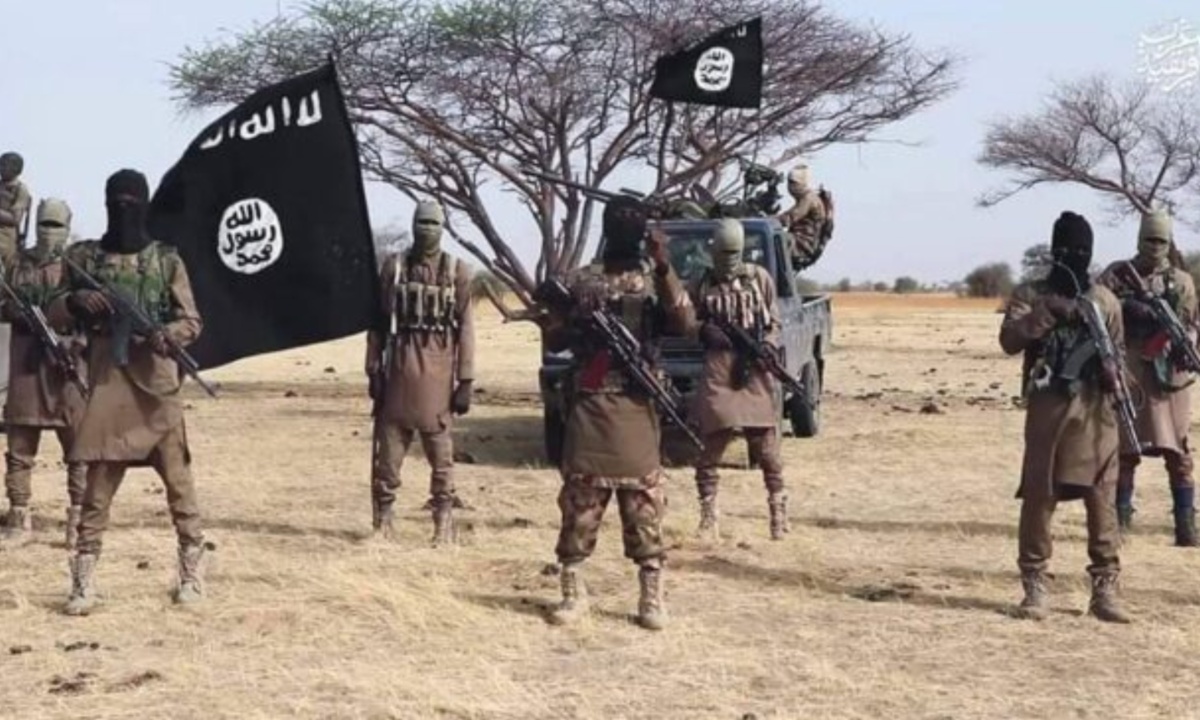
The Islamic State West Africa Province (ISWAP) has reportedly introduced financial rewards for fighters who capture weapons and military equipment during attacks on Nigerian security forces, according to a new report by the Institute for Security Studies (ISS).
Sponsored Ads
The report, titled Wiring the Insurgency: Inside ISWAP’s Adaptive Technology Programme, was published on Thursday. It examined how the insurgent group uses financial incentives to attract new members and retain existing fighters.
Sponsored Ads
ISS researcher and author of the report, Taiwo Adebayo, disclosed the payment structure in an interview with TheCable on Saturday. He explained that the amount offered depends on the type of weapon or equipment captured.
According to Adebayo, ISWAP pays $750 for an AK-47 rifle, $1,000 for a rocket-propelled grenade and between $500 and $1,000 for a box of ammunition, depending on its calibre. A pickup truck fitted with a heavy weapon reportedly attracts a reward of up to $30,000.
The payments are made in naira and represent substantial sums within the Lake Chad Basin economy. Adebayo said the arrangement had operated for several years and had developed into an organised recruitment and retention strategy.
Interviews with former insurgents indicated that financial incentives were a major motivation for joining the group, particularly among people facing economic hardship or those recruited through coercion rather than religious conviction. Some former fighters reportedly believed that ISWAP would struggle to retain newer members without the rewards offered for captured military equipment.
The report identified Nigerian military installations as major targets because attacks on the facilities provide the insurgents with access to firearms and ammunition. Since 2025, ISWAP has reportedly carried out several assaults on military bases, although the total quantity of weapons seized remains unknown.
A senior Nigerian intelligence source confirmed that the insurgents had taken weapons from the military, describing the situation as one in which the military appeared to be supplying arms to the group.
In March, ISWAP claimed to have captured 54 rifles, 20 machine guns and eight heavy weapons, including rocket-propelled grenade launchers and mortars. Former fighters also told the researcher that the group obtains weapons through smuggling routes from N’Djamena, Chad.
RELATED STORIES
Related Posts
The findings further revealed that ISWAP’s financial operations receive support from the Islamic State’s central leadership in the Middle East, which reportedly provides funds used to reward fighters.
Beyond weapons, the report identified Kano and Lagos as major supply centres for technology and equipment used by the insurgents, including drones, camcorders, boat engines and satellite communication devices.
Some Thuraya and Starlink devices are reportedly transported from Dubai in the United Arab Emirates to Kano through currency exchange networks. The equipment is registered in Dubai before being moved to Nigeria.
People interviewed for the research identified a Kano-based currency exchange operator as allegedly involved in facilitating the supply network. From Kano, intermediaries reportedly conceal the equipment in ordinary commercial consignments, including bundles of fabrics and food supplies.
The items are then moved through locations such as Geidam in Yobe State before reaching villages and markets, where ISWAP members or their representatives collect them.
Other equipment, including DJI Mavic drones, boat engines and media devices purchased from commercial outlets in Lagos, reportedly follows similar routes through Kano. N’Djamena was also identified as another source of supplies for the insurgents.
The report explained that currency exchange operators play a role in transferring funds between Islamic State’s central leadership and ISWAP, as well as facilitating payments to suppliers. Some operators are allegedly attracted by the profits from transactions conducted at rates above prevailing market prices.
In 2022, the Nigeria Sanctions Committee accused 13 individuals and three companies with physical addresses in Kano of involvement in terrorism financing. Nearly half of the individuals were reportedly currency exchange operators who had been convicted and jailed in the United Arab Emirates in 2021 for facilitating financial transactions between Dubai and Nigeria on behalf of terrorists.
One of those named was Surajo Abubakar Mohammed. However, the report said it was unclear whether he was the same person identified by interviewees as Alhaji Surajo.
In June, the United States also imposed sanctions on a Nigeria-based operator accused of helping ISIS move funds across international borders through money exchange businesses.

Comments are closed.