

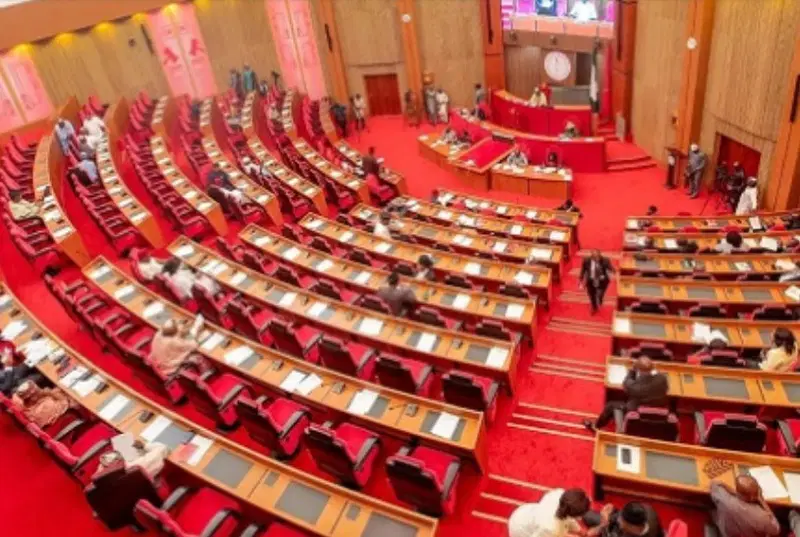
The Senate has approved President Bola Tinubu’s 2026–2027 supplementary external borrowing plan of $20.517 billion and €1.045 billion, estimated at a combined N29.6 trillion.
Sponsored Ads
The upper chamber also approved an additional external borrowing request of N10.79 trillion to finance the deficit in the 2026 Appropriation Act.
Sponsored Ads
The approvals followed consideration of a report by the Senate Committee on Local and Foreign Debts, chaired by Senator Aliyu Wamakko. The report was presented by the committee’s Vice Chairman, Senator Tokunbo Abiru.
The supplementary borrowing plan comprises $20.517 billion, estimated at N28 trillion, and €1.045 billion, valued at approximately N1.6 trillion. The funds are intended to support government projects and fiscal commitments under the 2026 and 2027 borrowing programme.
The Senate was also asked to approve arrangements to facilitate access to a $7.7 billion external loan already captured in the 2026 budget. However, lawmakers clarified that the facility was an existing budget provision and did not represent additional borrowing.
Under the Federal Government’s 2026 fiscal projections, revenue is estimated at N33.7 trillion, while expenditure is projected at N65.1 trillion, leaving a deficit of N31.4 trillion, representing 5.6 per cent of the Gross Domestic Product.
Domestic borrowing is expected to contribute N18.4 trillion, accounting for about 63 per cent of the planned financing, while external borrowing is projected at N10.79 trillion, representing the remaining 37 per cent.
Defending the proposals, Deputy Senate President Jibrin Barau dismissed concerns that the new facilities would push Nigeria beyond internationally recognised debt sustainability limits.
He put the country’s debt-to-GDP ratio at approximately 35 per cent, saying it could rise to 42 per cent after the proposed borrowing, still below the 70 per cent threshold.
RELATED STORIES
Related Posts
Barau explained that the $20.517 billion and €1.045 billion facilities would not be accessed immediately. According to him, individual projects and funding requests would be assessed based on stipulated requirements and national priorities before funds were released.
He also noted that the borrowing arrangement covered financing needs of state governments alongside those of the Federal Government.
On the additional N10.79 trillion request, Barau said the borrowing was already provided for in the 2026 Appropriation Act and was required to support budget implementation.
Chairman of the Senate Committee on Appropriations, Senator Olamilekan Adeola, also supported the proposals but called for stronger legislative oversight to ensure that borrowed funds were properly utilised.
He identified the Lagos-Calabar Coastal Highway, Sokoto-Badagry Superhighway and Kaduna-Kano railway project as examples of infrastructure projects receiving funding through borrowing arrangements.
Adeola urged relevant National Assembly committees to intensify monitoring of ministries, departments and agencies responsible for managing the facilities.
Senate President Godswill Akpabio disclosed that the first borrowing request was submitted to the upper chamber on October 2, 2026.
He said the Committee on Local and Foreign Debts spent approximately six weeks examining the proposals before presenting its report.
Akpabio added that the approval would allow the Federal Government to approach international financial markets, identify suitable sources of funding and negotiate favourable terms and conditions.

Comments are closed.