

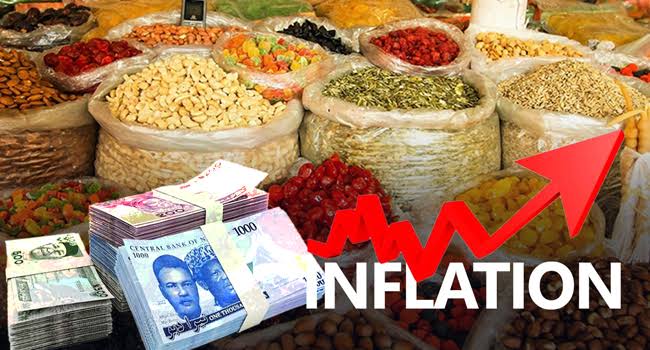
Economists and financial analysts have questioned the accuracy of Nigeria’s October 2026 inflation figures, arguing that the reported decline does not reflect the rising cost of food and other essential commodities in local markets.
Sponsored Ads
The National Bureau of Statistics (NBS), in its Consumer Price Index and Inflation Report released on Monday, put headline inflation at 14.06 per cent in October, while food inflation declined to 19.13 per cent.
Sponsored Ads
The report also showed that month-on-month headline and food inflation stood at 0.43 per cent and 0.75 per cent, respectively. Core inflation, which excludes volatile agricultural produce and energy prices, dropped to 10.78 per cent year-on-year from 21.25 per cent recorded in October 2025.
A breakdown of the figures showed that Yobe recorded the highest month-on-month food inflation at 18.41 per cent, followed by Kebbi with 16.45 per cent and Borno at 13.96 per cent.
Lagos recorded the lowest rate at -5.93 per cent, followed by Plateau at -5.83 per cent and Benue at -5.49 per cent.
Despite the reported decline, some analysts have expressed concerns that the official statistics may not adequately represent the financial pressure households continue to experience.
They argued that the difference between the NBS figures and prices in local markets could affect economic planning by giving policymakers an inaccurate picture of the cost of living.
A prominent economist and former President of the Chartered Institute of Bankers of Nigeria, Okechukwu Unegbu, faulted the food inflation figures, saying his observations of market prices did not support the reported decline.
RELATED STORIES
Related Posts
Unegbu said the prices of food items continued to rise, citing meat and yam as examples. He noted that meat which previously sold for about N5,000 could cost as much as N7,500, while a tuber of yam could sell for between N2,500 and N3,000, compared with lower prices in the preceding month.
He argued that the figures could mislead the public about the actual cost of living and make it difficult for the government to properly assess economic conditions and develop appropriate policies.
Unegbu, however, suggested that delays between data collection and the release of inflation reports could partly explain the differences between official figures and current market prices.
Similarly, financial analyst and Chief Executive Officer of SD & D Capital Management, Gbolade Idakolo, attributed the perceived gap to limitations in the NBS data collection and sampling methods.
Idakolo argued that the samples used by the bureau might be too limited to capture the economic conditions across the country accurately.
He also expressed concern about what he described as inadequate funding for the statistical agency, saying broader data collection was necessary to produce more reliable inflation measurements.
According to him, the declining purchasing power of Nigerians, alongside high energy, transportation and food costs, raises questions about whether the reported inflation figures reflect improvements in household living conditions.
Idakolo warned that relying solely on the statistics could create the impression that economic conditions were improving while many Nigerians continued to struggle with rising expenses.
He called for more comprehensive data collection to help the government understand the pressures facing households and introduce appropriate measures to ease the cost of living.

Comments are closed.