

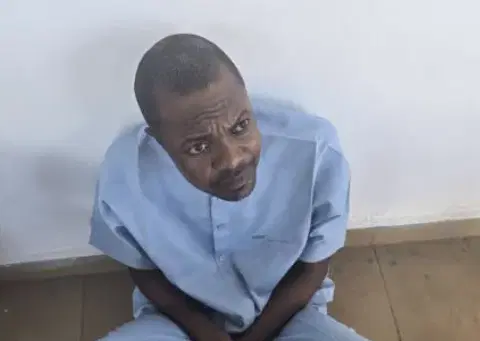
The controversy surrounding the alleged Presidential Foreign Investment Promotion Council (PFIPC) took a fresh turn on Wednesday as the Senate again declined to investigate the budget allocation linked to the organisation, while former Vice President Atiku Abubakar and the Presidency disagreed over how the matter should be handled.
Sponsored Ads
The Senate’s decision came days after the Nigerian Police arrested Adeniyi Adeyemi, who presented himself as the Director-General of the alleged council. His arrest followed a bench warrant issued by a Federal High Court in Abuja after he failed to appear for arraignment on charges bordering on conspiracy, forgery and impersonation.
Sponsored Ads
Adeyemi is also involved in a dispute with the Chief of Staff to the President, Femi Gbajabiamila, after alleging that the presidential aide demanded a ₦400 million bribe and requested 48 per cent of the council’s proposed ₦27.4 billion take-off grant.
Following the controversy, President Bola Tinubu directed the Independent Corrupt Practices and Other Related Offences Commission (ICPC) to investigate the circumstances surrounding the alleged agency and the budget allocation made for it. The commission is expected to conclude its investigation within 30 days.
Despite the ongoing probe, Atiku insisted that an independent investigation outside the executive arm of government was necessary.
The former Vice President also questioned a reported ₦6.44 billion allocation in the 2026 budget for Nigeria’s World Cup qualifying campaign despite the country’s elimination before the budget was presented.
Speaking through his Senior Special Assistant on Public Communication, Phrank Shaibu, Atiku said the PFIPC controversy was a test of the Federal Government’s commitment to transparency and accountability.
He argued that the issue extended beyond the activities of Adeyemi and raised concerns about how an organisation now described by the Presidency as non-existent allegedly secured office space within the Federal Secretariat, recruited staff, received diplomatic recognition and obtained budgetary allocations.
Atiku maintained that the real concern was how the alleged agency gained access to government institutions and enjoyed privileges usually reserved for recognised public bodies.
He also questioned the inclusion of the ₦6.44 billion allocation for a presidential support group connected to the 2026 FIFA World Cup qualifiers, asking why such spending appeared in the budget after Nigeria had already failed to qualify for the tournament.
According to him, the allocation raised fresh concerns about the credibility of the country’s budgeting process and suggested that public funds could be inserted into the budget without proper justification.
The former Vice President also expressed concern that Adeyemi’s arrest could shift public attention away from wider issues connected to the controversy.
Although Adeyemi has been accused of forgery, impersonation and obtaining money under false pretences, Atiku said the allegations against him and those he made against public officials should be investigated through an independent process.
He argued that the ICPC investigation ordered by President Tinubu would not convince the public because it was being handled within the same government facing the allegations.
Atiku therefore urged the National Assembly to establish an independent bipartisan panel to investigate every aspect of the alleged agency, while also calling on the Nigerian Bar Association, civil society organisations and the diplomatic community to support a transparent inquiry.
He said Nigerians deserved to know who approved the agency, who facilitated its access to government institutions, how it secured office accommodation, how it obtained diplomatic recognition, who inserted funds for it into the national budget and who benefited from its activities.
Responding to Atiku’s position, the Presidency insisted that the ICPC investigation remained the proper and lawful process for handling the matter.
The Presidency also questioned Atiku’s confidence in Nigeria’s public institutions, arguing that the anti-corruption agency had the legal responsibility to investigate such allegations.
Senior Special Assistant to the President on Media and Publicity, Temitope Ajayi, said there was no need for another investigation outside the ICPC since the commission had already been directed by the President to handle the case.
He also questioned why Atiku appeared unwilling to trust the institutions he would rely on if he eventually became President.
RELATED STORIES
Related Posts
Meanwhile, the Senate refused fresh calls to investigate the issue, maintaining that the matter was already before the courts and under investigation by the ICPC.
The controversy has remained in public discussion for more than two weeks after reports emerged that the alleged agency received a ₦1.3 billion allocation in the 2026 Appropriation Act despite the Presidency insisting that no such agency existed.
The renewed motion was presented by Senator Suleiman Kawu, who represents Kano South Senatorial District. He had made a similar request the previous week, but it was rejected.
Kawu again urged the Senate to investigate how the allocation found its way into the 2026 budget, but lawmakers declined to proceed with the proposal.
President of the Senate Godswill Akpabio ruled that the National Assembly could not investigate a matter already before a court and also noted that President Tinubu had already ordered the ICPC to investigate the issue within 30 days.
He said beginning another Senate investigation while the matter was before the court and under investigation would not be appropriate.
Kawu had earlier argued that the National Assembly had a constitutional duty to investigate how the allocation entered the national budget, regardless of the executive’s separate investigation.
He maintained that his concern was protecting the credibility of the National Assembly’s appropriation process and determining how the ₦1.3 billion allocation was approved.
On Wednesday, he again attempted to raise the matter under urgent public importance, but senators maintained their earlier position and refused to debate it.
The controversy widened after Adeyemi’s arrest on Tuesday over allegations of forgery, impersonation and obtaining money under false pretences.
Despite the arrest, opposition figures continued to insist that only an independent investigation outside the executive branch could gain public confidence because senior government officials had been mentioned in the allegations.
The Federal Government has already filed criminal charges against Adeyemi over alleged impersonation and related offences.
Fresh information also emerged on Wednesday about how Adeyemi was eventually arrested after weeks of evading security agencies.
Security sources disclosed that operatives of the Intelligence Response Team tracked him for about five days after he arrived in Osun State before arresting him near Ilesa.
According to the sources, the police team had originally been deployed to Osun for another security assignment following recent violence in the state, but Adeyemi was already on the IRT watchlist.
Investigators reportedly discovered his location after days of surveillance and moved in to arrest him.
The sources also revealed that Adeyemi had earlier stayed in Ibadan, Oyo State, where operatives of the Department of State Services monitored him but did not arrest him before ending the operation.
Before carrying out the arrest, the IRT reportedly informed the Osun State Commissioner of Police, Ibrahim Gotan, and also briefed him after the operation was completed.
To avoid attracting public attention, the operatives did not take Adeyemi to the Osun State Police Command headquarters in Osogbo. Instead, he was moved to Ibadan before being transferred to Abuja for further investigation and prosecution.

Comments are closed.