

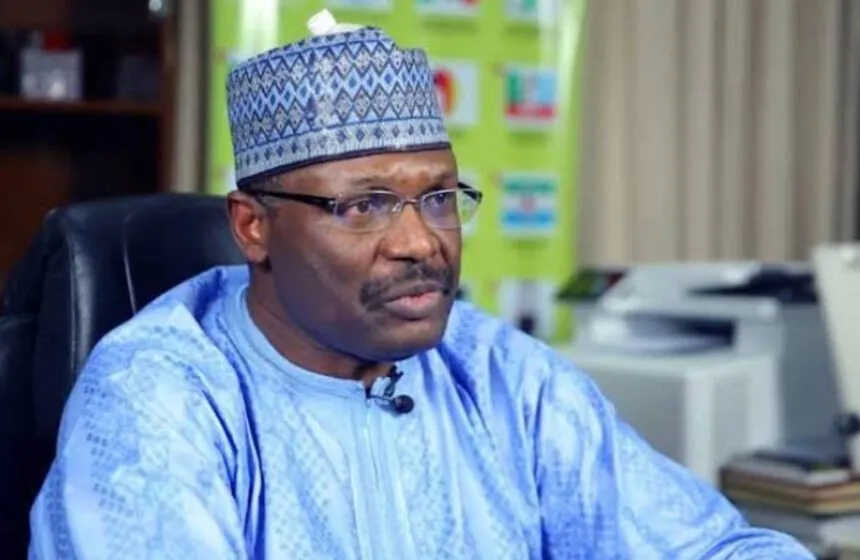
As the tenure of the Independent National Electoral Commission (INEC) Chairman, Professor Mahmood Yakubu, draws to a close, conversations about his potential successor are gaining intensity across Nigeria’s political landscape.
Sponsored Ads
Yakubu, appointed in 2015, will officially end his second term in October 2025 after a decade in charge, during which he supervised two general elections — in 2019 and 2023.
Sponsored Ads
Nigerians are now questioning what kind of individual should take over the reins at the electoral body and whether the appointment will reflect national fairness or continue old political patterns. While some believe the process will be straightforward, others are skeptical, fearing that the selection might not inspire confidence in the 2027 elections.
The major concern for many is regional representation. Some political voices are pushing for the next INEC chairman to come from the North-Central region — a zone that has never held the position. Others argue the South-South or South-East should be considered for fairness, especially since the current chairman is from the North-East and the president from the South-West. These discussions have ignited subtle lobbying from various regions, hoping to tip the scale in their favor.
Under Nigeria’s constitution, the president nominates the INEC chairman, and the National Assembly confirms the appointment. However, critics argue this structure limits independence. Prominent individuals, including former officials and civil society leaders, have raised concerns about the president’s power in this matter, warning that political interests could overshadow credibility and neutrality.
Former Ohanaeze spokesperson, Dr. Alex Ogbonna, dismissed hopes of a fair process, pointing to what he sees as a pattern of partisan appointments. Similarly, Dr. Akin Fapounda, a retired federal official, suggested scrapping the federal INEC entirely in favor of zonal electoral bodies to remove the risk of centralized manipulation.
Some voices, like Professor Chidi Odinkalu, argue that President Tinubu may appoint someone from his ethnic group, which he believes would mirror the trend of other appointments under the current administration. Concerns about religious and ethnic imbalances were also raised by others, who warned that further divisions could deepen mistrust in the electoral system.
RELATED STORIES
Related Posts
For groups like the Middle Belt Forum, this appointment is a chance to bring in a truly neutral figure. Its leader, Dr. Bitrus Pogu, urged the president to select someone unshakable in integrity and free from political or financial pressure. He believes the North-Central deserves a shot, not just for regional balance but to restore public faith.
Others, including retired General John Sura and lawyer Monday Ubani, suggested that the next chairman should come from civil society or the judiciary — people with records of public service, fairness, and accountability. They expressed disappointment in past academic appointees and called for a new approach, potentially bringing in a retired judge or even a clergyman known for their moral uprightness.
However, not everyone is focused on zoning. Former senator Professor Sola Adeyeye stressed that character should be the top consideration, not the region of origin. A similar view was shared by Anthony Sani of the Arewa Consultative Forum, who called for strengthening democratic institutions rather than reducing everything to ethnic representation.
Some, like former Kogi State Speaker Abubakar Bello, maintained that while regional origin shouldn’t be ignored, the next chairman must be someone who can lead without fear or bias, similar to Professor Attahiru Jega, under whose leadership INEC earned respect during the 2011 elections.
Others went further to challenge the current structure. Legal experts such as Mr. Shipi Rabo advocated for constitutional reform to remove the appointment power from the president entirely, recommending that the National Judicial Council take charge of the process. This, he said, would protect INEC’s independence and build voter trust.
Suggestions also came from academics, such as Dr. Abdullahi Yalwa, who emphasized qualities like administrative competence, digital literacy, and national loyalty. In his view, educational background should be non-negotiable, but region and religion should be secondary.
Adding an unusual perspective, APC chieftain Muhammad Aminu Tukur proposed that a respected religious figure — a bishop or sheikh — could be a fitting choice. He believes that individuals grounded in moral principles may be better suited to protect the integrity of elections.
As the nation prepares for the post-Yakubu era, the direction of this appointment will likely influence not just the 2027 elections but the broader trajectory of Nigeria’s democracy. The stakes are high, and for many, the question remains: Will this be the moment the system shifts towards true impartiality, or will it follow the familiar road of political convenience?

Comments are closed.